
Cyber Insurance Readiness
Can We Insure This?
Cyber insurance readiness is about more than qualifying for a policy. It requires understanding the risk, answering underwriting questions accurately, validating the controls behind those answers, knowing how the business would recover and making deliberate decisions about the financial consequences the organization retains or transfers.
A body of work by Patrick M. Hayes exploring cybersecurity, underwriting, recovery and business survivability.
What Does “Can We Insure This?” Mean?
“Can we insure this?” has two meanings. At the transactional level, an organization wants to know whether an insurer will accept a risk and on what terms. At the organizational level, Patrick M. Hayes uses the question to examine whether the business understands the risk it is asking another party to insure. That means understanding the technology, security controls, supporting evidence, business dependencies, recovery capability and potential financial consequences behind an application. The question is broader than the title of a book: it connects Patrick’s writing, practical application guidance and instructor-led learning around cyber insurance readiness. Obtaining a policy is not the end state. The organization still needs to know how it would operate through disruption, how meaningful activity would recover and which financial consequences it deliberately retains or transfers.
The Cyber Insurance knowledge hubBefore Asking an Insurer to Take the Risk, Understand the Risk
An application translates technical and operating conditions into representations about risk. Questions about MFA, endpoint security, backups, vulnerability management and incident response may look simple; the environment behind them often is not.
- What are we actually being asked?
- Who knows the answer?
- How was the answer verified?
- What evidence supports it?
- Does the control apply everywhere the answer implies?
- What happens if the control fails anyway?
Understanding the question matters more than checking a box. The answer needs to reflect the business as it operates—not a purchase, assumption or intended future state.
The Goal Is Not to Answer Yes
The goal is not to answer “yes.” The goal is to answer accurately.
An insurance application is not simply a cybersecurity checklist. Its answers are representations used as part of an underwriting decision. A control can exist somewhere without being deployed, configured or enforced across the environment the answer implies.
Insurers ask questions differently and use different processes. Understand what the particular question represents, identify qualifications and verify the actual answer before submitting it.
Cyber Insurance Application Guide →From answer to evidence
Can You Prove the Answer?
A question connects to an answer, a verifier, supporting evidence and a verification date. The Workshop’s Evidence File uses the following exact minimum field labels to make that connection traceable.
Material Question
What exactly is the insurer asking, including the scope implied by the wording?
Submitted Answer
What representation is the organization making in response?
Verifier
Who has sufficient knowledge or authority to validate that answer?
Evidence
What information supports the representation, its enforcement and its scope?
Verified Date
When were the answer and supporting information validated?
This records who verified a representation, what supported it and when. It is a practical way to understand an answer—not a universal carrier requirement or prescribed legal process.
Exists → Enforced → Scoped → Evidenced
The Workshop distinguishes whether a control exists, whether it operates as a requirement, which scope it covers and whether evidence supports the representation. A written policy and an enforced operating control are not the same.
- Exists
- The control has been implemented somewhere in the environment.
- Enforced
- The control is required and operates, rather than being optional or only written into a policy.
- Scoped
- Its reach matches the users, systems and access paths described by the question.
- Evidenced
- Reliable records or testing support the answer and its relevant scope at the time it is given.
Underwriting evidence expectations vary among insurers.
Cyber Insurance Underwriting EvidenceWhat Are You Actually Insuring?
The first Workshop block moves beyond the assets and controls to the consequence for the business when technology, security or an operating dependency fails.
- What business capability depends on the technology?
- What happens when it becomes unavailable?
- Who is affected?
- What obligations emerge?
- How long can the business tolerate disruption?
- What does the interruption cost?
Cyber insurance cannot be understood solely as a cybersecurity purchase. The technology matters because of the business activity, obligations and value that depend on it.
Follow the Loss
The Workshop’s Follow the Loss exercise traces how a technical event moves through the organization into operational disruption and financial consequence. A service becoming unavailable can interrupt customer delivery, affect contractual obligations and create recovery expenses or lost revenue.
The point is to follow the consequence beyond the security boundary: which activity stops, who depends on it, what it takes to restart and what the interruption costs. This is an established exercise, not a newly branded sequence or a universal interpretation of insured loss.
Would the Business Survive the Claim?
A successful insurance claim does not automatically mean successful business recovery. Insurance may provide financial capacity and response resources for certain covered losses; the business still needs the operational capability to resume meaningful activity.
- Technical restoration
- Returning infrastructure, systems, applications and data to operation.
- Business recovery
- Restoring the ability to serve customers, generate revenue, meet obligations and continue creating value. People, providers and processes may constrain that recovery even after systems return.
Insurability Is Not the Same as Survivability
Security influences risk. Recovery influences consequence. Insurance provides financial capacity for certain covered consequences. Business survivability depends on how those capabilities work together when disruption occurs.
Underwriting and controls can improve insurability while substantial dependencies and recovery risks remain. A policy neither eliminates those risks nor guarantees recovery.
Read Patrick’s insurability and survivability discussion →The established Workshop dimensions
A Practical View of Cyber Insurance Readiness
Understand, Verify, Control, Recover and Finance connect the application to the business behind it. They are a practical readiness lens, not an industry standard or insurer-mandated methodology.
Understand
Identify what the business depends on, what could disrupt it and how an incident could become a financial loss.
Verify
Check the actual answer to a material application question, who can verify it and what evidence supports it.
Control
Understand whether safeguards operate across the relevant environment, who owns them and where gaps remain.
Recover
Establish how critical business operations would resume, including the people, providers and systems they require.
Finance
Consider disruption costs, available financial capacity and the consequences the business retains or transfers.
The Workshop uses Confident, Needs Validation and Known Gap to help participants reflect on readiness. These are not underwriting grades, maturity scores or guarantees of insurance eligibility.
From Readiness to Action
Finding a gap is useful when it leads to a deliberate next step. The existing 90-Day Readiness Action Plan connects Workshop findings to priorities such as:
- Answers requiring verification
- Controls requiring validation
- Known gaps
- Recovery assumptions requiring testing
- Evidence requiring improvement
- Business dependencies requiring further analysis
Sensitive organizational evidence belongs in the organization’s approved systems. This public page does not collect application responses, evidence or business data.
Read · Listen · Prepare · Learn · Apply
The Can We Insure This? Body of Work
- Read
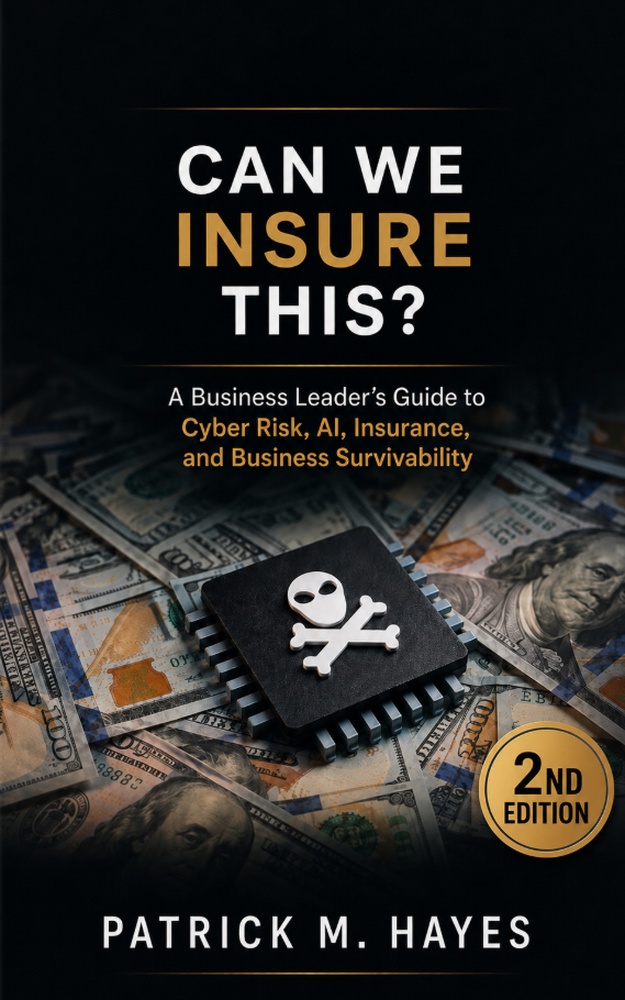
The Second Edition is the foundational book exploring the relationship among cybersecurity, underwriting, recovery, financial consequence and business survivability.
Can We Insure This? Second Edition- Listen
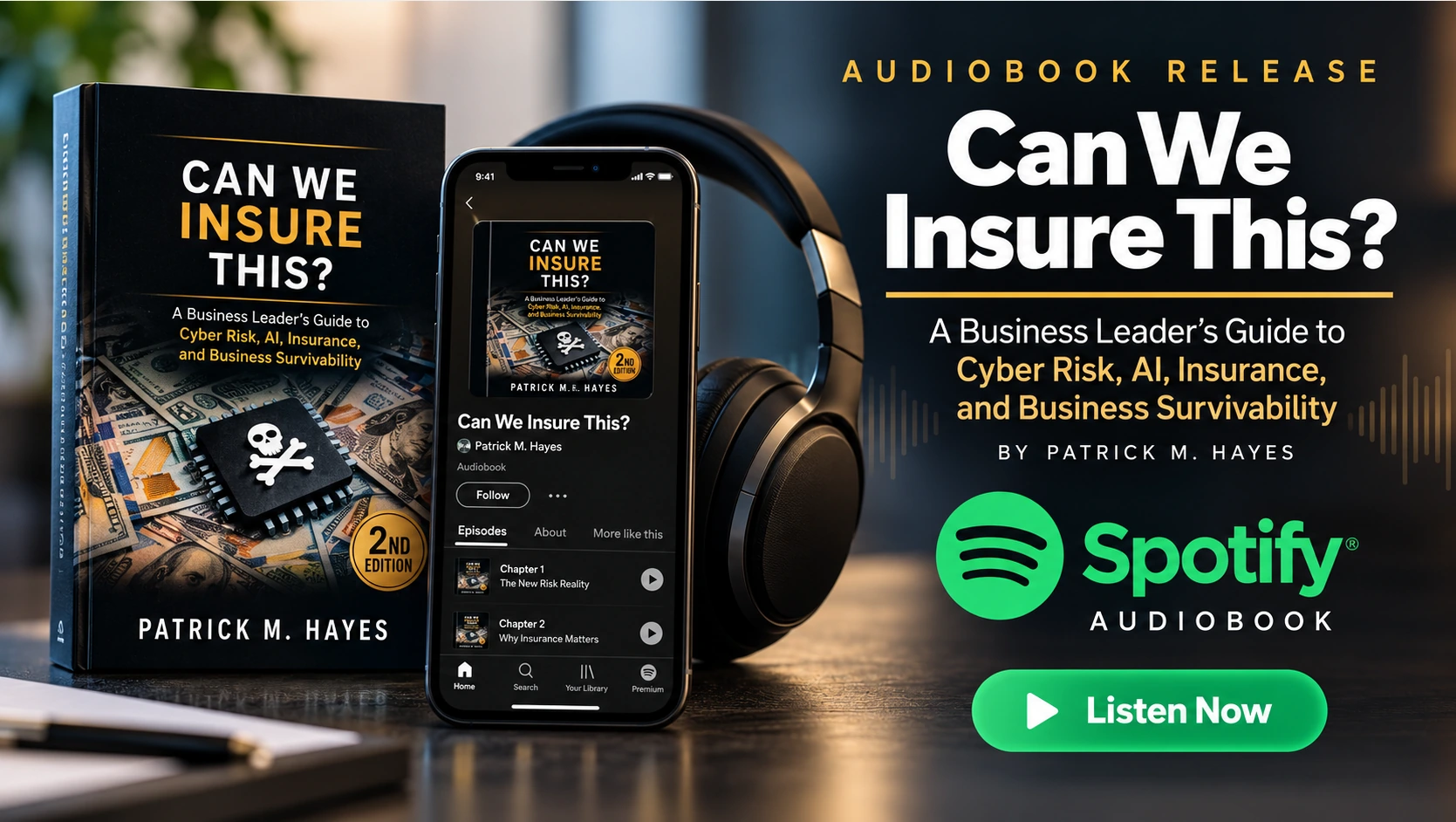
The Second Edition is also available as an audiobook.
Listen on Spotify- Prepare
The Application Guide helps interpret common questions, identify appropriate verifiers and prepare supporting information before submission.
- Learn
The three-hour instructor-led Practical Cyber Insurance Readiness Workshop connects understanding the risk, proving the answer and examining whether the business would survive the claim. It is distinct from general Academy membership.
Can We Insure This? Workshop- Apply
- The Workshop toolkit includes the Student Workbook, sample application, evidence worksheets and templates, Business Impact & Recovery Worksheet, Readiness Assessment and 90-Day Action Plan. Protected participant downloads remain in the Workshop workspace.
Cyber Insurance Is a Business Decision
Cybersecurity explains controls and technical exposure. Operations understands business dependencies and recovery. Finance considers tolerance and financial consequence. Brokers and insurers bring insurance expertise. Leadership needs to understand the combined business decision.
No discipline is subordinate to another, and no one perspective provides the entire answer.
Helping Clients Answer Better Questions
Brokers may encounter clients who do not fully understand technical underwriting questions. Patrick’s work bridges the language of insurance, cybersecurity and the business by helping clients identify who knows an answer and what supports it.
It complements rather than replaces licensed insurance advice. Brokers help clients navigate the application and transaction; knowledgeable client teams validate their operating and technical representations.
Cyber Insurance Application Guide →Underwriting Approaches Vary
Insurers differ in underwriting questions, evidence expectations, control requirements, appetite, pricing, limits, retentions, exclusions, coverage and processes.
Patrick’s commentary on Coalition or another carrier illustrates that insurer’s approach. It must not be treated as the way every cyber insurer evaluates risk.
The Broader Integrated Assurance Question
Cyber risk crosses security, technology, operations, governance, finance, recovery and insurance. No single discipline owns the entire consequence. Can We Insure This? is a practical example of the broader problem addressed by Integrated Assurance®—while remaining its own recognizable body of work.
Explore Integrated Assurance®About the Author
Patrick M. Hayes is the author of Can We Insure This? and Integrated Assurance: Unified Risk Strategy. He writes and teaches about cybersecurity, cyber insurance, enterprise risk, recovery and business survivability.
About Patrick M. HayesQuestions & Answers
What does “Can We Insure This?” mean?
It asks both whether an insurer will accept a risk and whether the organization understands that risk well enough to represent it accurately, support its answers and make informed recovery and financial decisions.
Is Can We Insure This? only a book?
No. It is also Patrick M. Hayes’s body of work on cyber insurance readiness, including the Second Edition book and audiobook, Application Guide, practical Workshop and related writing. The book remains a distinct publication within that work.
What is cyber insurance readiness?
It is understanding the exposure, verifying application answers, validating relevant controls, examining recovery capability and considering retained or transferred financial consequences. Patrick’s Workshop uses Understand, Verify, Control, Recover and Finance as a practical readiness view, not an insurer standard.
How should a company prepare for a cyber insurance application?
Read each question carefully, identify a knowledgeable verifier, check the answer’s scope and evidence and clarify exceptions or uncertainty before submitting it. Examine recovery dependencies and discuss the application with the broker. The objective is accuracy, not maximizing yes answers.
Why is evidence important in cyber insurance underwriting?
Evidence helps connect an application answer to what actually operates in the organization. It can show how a control is enforced and which scope the answer covers. Insurer requirements vary; no single evidence collection automatically satisfies every underwriter.
Does every cyber insurer require the same security controls?
No. Questions, control expectations, evidence, appetite and processes can vary materially. Commentary about Coalition or another insurer describes a particular approach, not a universal requirement.
Does having cyber insurance mean a business is prepared for a cyberattack?
No. Insurance can provide financial capacity and response resources for certain covered losses. The organization still needs security, response arrangements and the ability to restore meaningful operations.
What is the difference between insurability and survivability?
Insurability concerns whether a risk is acceptable to an insurer and on what terms. Survivability concerns whether the business can continue or recover meaningful activity through disruption. A policy does not establish that every operational dependency or financial weakness has been addressed.
What is the Cyber Insurance Application Guide?
Patrick’s practical guide helps business leaders understand common application topics, identify who can verify answers and consider supporting information before submission. It is available as a free PDF and as an audiobook on the Cyber Insurance Application Guide page.
What is the Can We Insure This? Workshop?
It is the existing three-hour instructor-led Practical Cyber Insurance Readiness Workshop, organized around understanding what is being insured, proving application answers and examining whether the business would survive the claim. It is distinct from general Academy membership.
This material is educational and informational and does not constitute legal, insurance, underwriting or coverage advice. Insurance coverage and underwriting requirements vary by insurer and policy.