
Cyber Insurance
Cyber Insurance, From Application to Recovery
Cyber insurance begins long before a claim. Organizations need to understand the risk they represent, know whether controls operate as described, understand how the business would recover and decide which financial consequences they retain or transfer.
What Is Cyber Insurance?
Cyber insurance is a form of risk transfer designed to provide financial protection for certain losses associated with cyber incidents and technology-related events. Depending on the policy, it may address costs the organization incurs itself and liability arising from claims by others. Protection is subject to the specific terms, conditions, limits, retentions, exclusions and coverage of the policy; buying insurance does not mean every cyber-related loss is covered. Coverage varies by insurer and policy, including the events that trigger protection, the services available and the way a loss is measured. Cyber insurance complements cybersecurity and recovery planning rather than replacing either. The business still needs to understand its exposure and its ability to operate through disruption. An insurance broker can help explain available coverage options in the context of the organization’s needs.
By Patrick M. Hayes · An educational reference on risk transfer and business readiness.
What Can Cyber Insurance Cover?
Common categories can include costs incurred by the business and liability to others. These are examples to discuss with a broker—not a universal coverage checklist.
- Response & investigation
- Incident response, forensic investigation, legal support, notification and privacy-related expenses may be addressed by a policy.
- Extortion response
- Ransomware and cyber extortion response may be covered, with policy-specific requirements, limitations and conditions.
- Business interruption & restoration
- Some policies address covered interruption losses, data restoration and other recovery costs. Operational loss and insured loss are not necessarily the same.
- Liability & defense
- Third-party liability, regulatory defense where covered and other covered costs may be included. The particular wording and applicable law matter.
Actual coverage depends on the policy.
General coverage context: NAIC small-business cyber insurance overview.
Cyber Insurance Is More Than a Policy
The insurance transaction is only one part of the risk lifecycle. Before deciding what to transfer, an organization needs to understand what it is protecting, what could disrupt it and which controls actually operate.
Leadership also needs to know which dependencies matter, how meaningful operations would be recovered, what disruption could cost and which financial consequences should be retained or transferred.
This is where cybersecurity, operations, finance, risk management and insurance intersect. Patrick’s work connects those decisions; it does not replace the expertise of brokers, carriers, underwriters, attorneys or practitioners.
Before the application. Beyond the policy.
The Cyber Insurance Readiness Lifecycle
The Can We Insure This? Workshop considers five connected readiness dimensions. Applying and underwriting take place within this broader decision process; they do not replace it. Readiness starts before the form and continues after a policy is issued.
- 01
Understand
Identify what the business depends on, what could disrupt it and how an incident could become a financial loss.
- 02
Verify
Check the actual answer to a material application question, who can verify it and what evidence supports it.
- 03
Control
Understand whether safeguards operate across the relevant environment, who owns them and where gaps remain.
- 04
Recover
Establish how critical business operations would resume, including the people, providers and systems they require.
- 05
Finance
Consider disruption costs, available financial capacity and the consequences the business retains or transfers.
These are connected questions, not a one-time checklist or a guarantee of insurability.
The Cyber Insurance Application Is a Risk Representation
Application answers describe the organization to the insurer. Questions may concern MFA, endpoint protection, email security, backups, vulnerability management, patching, security awareness, incident response and privileged access. Every insurer does not ask the same questions.
The goal is not to answer “yes.” The goal is to answer accurately.
Read the scope of each question. Identify who actually knows the answer, what evidence supports it and whether the control applies everywhere the answer implies. Partial or unknown information calls for verification and discussion—not an unsupported affirmative answer.
Explore the Application Guide →Available as a free PDF and audiobook.
From Security Controls to Underwriting Evidence
An organization may need more than a statement that a control exists. Patrick’s Workshop distinguishes existence, enforcement, scope and evidence when evaluating an application answer.
Exists
The control has been implemented somewhere in the environment.
Enforced
The control is required and operates, rather than being optional or only written into a policy.
Scoped
Its reach matches the users, systems and access paths described by the question.
Evidenced
Reliable records or testing support the answer and its relevant scope at the time it is given.
A policy can exist without being enforced. MFA can be enabled without protecting every relevant access path. A backup can exist without a successful recovery test. Evidence helps distinguish what leadership assumes from what the business can demonstrate.
Evidence requirements and underwriting processes vary; this is a way to understand an answer, not a claim that every underwriter uses the same method.
Cyber Insurance Underwriting EvidenceRead Patrick’s application and evidence discussion →Why Security Controls Matter to Cyber Insurance
Controls can influence both the likelihood and potential consequence of loss. That makes their operation relevant to underwriting—not simply their purchase or presence on a list.
- Access control & MFA
- Who can access critical systems, whether additional authentication is enforced and which access paths remain outside it.
- Endpoint protection
- Which devices are protected and who is responsible for acting when suspicious activity is detected.
- Vulnerability management & patching
- How weaknesses are identified, prioritized and addressed across the environment the business relies on.
- Backups & recovery
- Whether essential data is protected and whether restoration has been tested against business needs.
- Email security & security awareness
- How the organization manages malicious messages and prepares people to recognize and report suspicious activity.
- Incident response & privileged access
- Who can make urgent decisions, how elevated access is controlled and how response responsibilities are exercised.
The application defines what the insurer is asking. Leadership’s role is to connect the answer to accountable people and credible evidence.
When an old control becomes an insurance issue →Insurance Does Not Recover the Business
A policy can provide financial resources and access to response services. The organization still needs the operational capability to recover.
Technical restoration
Bringing systems, applications and data back into operation.
Meaningful business recovery
Restoring the ability to serve customers, generate revenue, fulfill obligations and continue creating value.
Restored systems do not automatically produce a restored business. People, providers, process dependencies and financial capacity may still constrain operations.
Explore Business SurvivabilityInsurable Does Not Necessarily Mean Survivable
An organization may qualify for insurance while retaining significant dependencies, recovery weaknesses or financial exposure. Controls that improve insurability do not eliminate cyber risk.
Security can reduce the likelihood or consequence of an event. Recovery determines how effectively meaningful operations can be restored. Insurance can provide financial capacity for certain covered consequences.
Together, these decisions affect business survivability. None is a substitute for understanding how the business would function under stress.
Read the insurability and survivability discussion →The Loss May Be Bigger Than the Security Incident
Incident response is only part of the financial impact. Disruption can affect revenue, customers, contractual obligations, recovery expenses and the cost of maintaining operations while services are unavailable.
Critical dependencies and time matter: which business activity stops, how long it can remain stopped and what it takes to restart. Understanding that exposure before a loss helps leadership make better recovery and financing decisions.
Business impact is not a universal interpretation of business interruption coverage. Insured loss is determined by the particular policy and circumstances.
Your Cyber Risk Includes the Companies You Depend On
Cloud providers, SaaS platforms, technology vendors, payment systems, managed service providers and other partners can be essential to ordinary business operations. Their disruption can become your disruption.
Underwriting and recovery conversations should consider those dependencies: what activity relies on a provider, who owns the relationship and what happens if service is unavailable. Not every third-party outage constitutes a covered cyber insurance claim.
Read Patrick’s third-party risk discussion →AI Is Changing Both Sides of Cyber Insurance
AI can affect threat activity, including phishing and social engineering. Inside the business, it can also change data exposure, automated decisions, operating processes and reliance on external technology.
Patrick’s AI and cyber insurance writing asks where AI is used, what data enters it, who validates outputs and how operations continue if it fails. These are questions about exposure, accountability and recovery—not a prediction that every insurer will adopt the same new requirements.
Shared technology dependencies also matter when considering accumulation and systemic risk: one provider’s disruption can affect many organizations. How an insurer evaluates that exposure, and which underwriting questions it asks, varies.
AI and Cyber Insurance: Patrick’s existing analysis →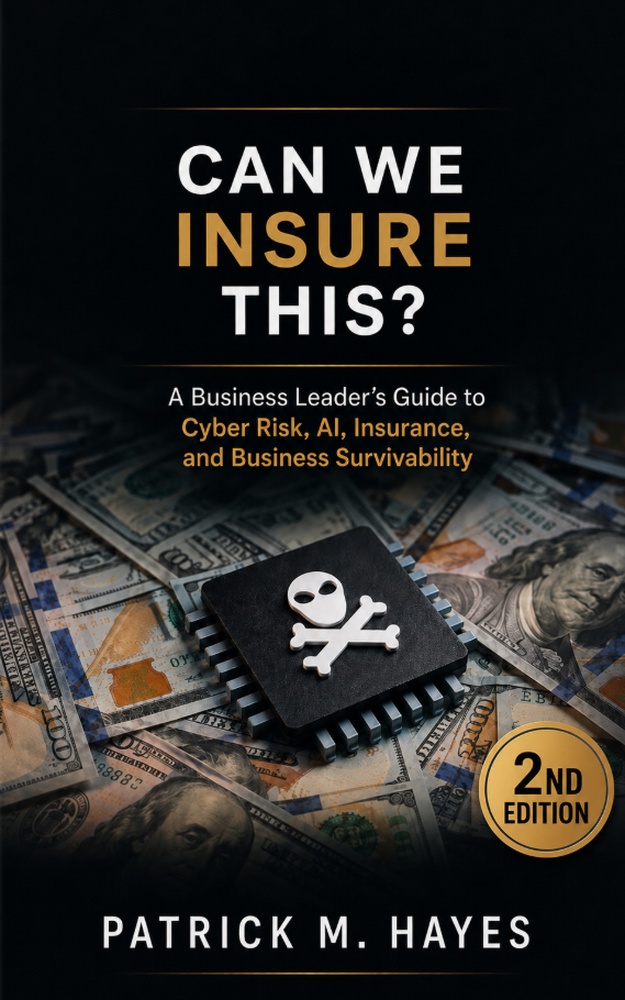
A connected body of work
Can We Insure This?
“Can we insure this?” is a larger question than whether an insurer will issue a policy. It asks whether the organization understands the risk well enough to represent it accurately, demonstrate how it is managed, understand how it would recover and deliberately decide which financial consequences it retains or transfers.
- Listen
- Listen on Spotify
- Prepare
- Explore the Application Guide →
Free PDF + Audiobook
- Apply
- The Workshop includes a workbook, sample application, evidence worksheets and templates, business impact and recovery worksheet, readiness assessment and 90-day action plan. These resources remain within the Workshop; participant files are not made public here.
Where the Insurance Broker Fits
Brokers help organizations understand available products, coverage options, market conditions and the insurance transaction. Patrick’s work is complementary to that role.
Security and operational teams validate the technical and operating answers behind an application. Finance and leadership consider the consequences they retain or transfer. Attorneys advise on legal obligations and policy questions within their expertise.
Cyber insurance becomes a shared decision, rather than solely an insurance purchase or a cybersecurity activity.
Not Every Insurer Underwrites Cyber Risk the Same Way
Questions, evidence requirements, appetite, controls, pricing, limits, retentions, exclusions, coverage and underwriting processes can vary materially among insurers.
Patrick sometimes examines particular carrier approaches, including Coalition and MSIG. Those are specific examples, not universal descriptions of the market or endorsements of one insurer for every organization.
The actual application and policy—not a generalized article or example—determine the details to discuss with your broker and other advisors.
Where Cyber Insurance Meets Integrated Assurance
Cyber insurance illustrates the broader Integrated Assurance® problem: one risk crosses security, technology, operations, finance, legal obligations, recovery and risk transfer. Separate answers can leave leadership without a coherent understanding of the business consequence.
Integrated Assurance connects those perspectives. Cyber Insurance and Can We Insure This? remain a distinct body of work within Patrick’s broader thinking.
Explore Integrated Assurance®Patrick M. Hayes and Cyber Insurance
Patrick M. Hayes is the author of Can We Insure This? and writes and teaches about the intersection of cybersecurity, cyber insurance, underwriting, recovery and business survivability. His broader work includes the Integrated Assurance® operating model.
This page explains that body of work. It does not position Patrick as an insurance carrier or provide individualized insurance or legal advice.
About Patrick M. HayesSelected Insights
Cyber Insurance Knowledge Center
Patrick’s writing on the application, the evidence behind it and the business that has to recover. Carrier-specific commentary describes particular examples; coverage and underwriting vary.
Underwriting & Evidence
- Before You Answer Your Next Cyber Insurance Application
September 7, 2026
- Cyber Insurance Applications Are Becoming an Accidental Business Stress Test
August 30, 2026
- Denied! Why Your Company Was Refused Cyber Insurance… and What It Really Means
April 8, 2026
- Cyber Insurance Is Moving Toward Continuous Underwriting
October 26, 2026
Security Controls
- Cyber Insurance Is Starting to Ask a Different Question
September 1, 2026
- When an Old Control Turns a Ransomware Event into an Uninsured Loss
April 27, 2026
Recovery & Business Interruption
AI & Emerging Risk
Third-Party Risk
- The Vendor You Trust Could Become Your Biggest Business Risk
July 3, 2026
- Who Approved the AI That Your Vendors Are Using?
September 24, 2026
Questions & Answers
What is cyber insurance?
Cyber insurance is financial risk transfer for certain losses associated with cyber incidents and technology-related events. Protection depends on the policy’s terms, conditions, limits, retentions and exclusions. It is not a replacement for security or recovery capability.
What does cyber insurance typically cover?
Potential categories include incident response, forensics, legal and notification expenses, extortion response, business interruption, data restoration and third-party liability. Not every policy includes every category, and the circumstances that trigger coverage vary.
What do cyber insurance underwriters look for?
Underwriters assess the exposure they are being asked to accept. They may consider the business’s activities, security controls, incident history, dependencies and recovery arrangements. Questions, evidence requirements and underwriting decisions differ among insurers.
Why does MFA matter for cyber insurance?
Multifactor authentication makes a stolen password alone less useful to an attacker. An underwriter may ask where it is enforced, including email, remote access or privileged accounts. Having MFA somewhere does not establish that all relevant access paths are protected.
What security controls are commonly asked about on cyber insurance applications?
Applications may ask about MFA, endpoint protection, email security, backups, vulnerability management, patching, security awareness, incident response and privileged access. Read the actual application: questions and the scope of an expected answer vary.
What evidence may be needed for a cyber insurance application?
Depending on the question, useful evidence can include configuration records, device coverage reports, training completion records or recovery-test results. Identify who can verify the answer and whether the evidence supports the scope represented. The insurer determines what it requires.
Does cyber insurance replace cybersecurity?
No. Cybersecurity manages the likelihood and potential consequence of an incident. Insurance can finance certain covered consequences that remain. Purchasing a policy does not implement or operate the organization’s security controls.
Does cyber insurance guarantee that a business can recover from a cyberattack?
No. A policy may provide financial resources and response services, but the organization still needs the operational capability to restore meaningful business activity. Systems, people, dependencies, obligations and cash flow all affect recovery.
What is the difference between insurability and survivability?
Insurability concerns whether an insurer will accept a risk and on what terms. Survivability concerns whether the business can continue or restore meaningful operations through disruption. An organization can qualify for insurance while retaining significant operational and financial weaknesses.
How should a business prepare for a cyber insurance application or renewal?
Understand the questions before answering, identify knowledgeable verifiers, check scope and supporting evidence, clarify partial or unknown answers and examine recovery dependencies. Discuss the actual application and coverage options with the broker rather than treating renewal as an IT form.
Does every cyber insurer use the same underwriting process?
No. Risk appetite, questions, evidence, required controls, pricing, limits, retentions, exclusions and processes can vary materially. Commentary about one carrier’s approach is an example, not a description of the whole market.
The material is educational and informational and does not constitute legal, insurance, underwriting or coverage advice. Coverage and underwriting requirements vary by insurer and policy.