Cyber insurance applications have changed quite a bit. What used to be a fairly straightforward questionnaire about firewalls, antivirus, and a few basic security practices has become a much closer look at how a business actually manages cyber risk. There is a reason for that. Insurers have years of claims experience showing them which conditions tend to make an incident more expensive. They are trying to understand how likely a loss is, how large it could become, and whether the business has the ability to keep a manageable incident from turning into a major financial event.
For business leaders, this creates a problem. Many of the questions look technical, so the natural response is to send the application to IT or an outside provider and ask them to fill it out. Eventually the answers come back, someone in leadership approves the application, and everyone moves on. I think that approach misses what the application has become and puts too much emphasis on completing the form rather than understanding what the business is actually telling the insurer.
This Is More Than an IT Questionnaire
The answers on a cyber insurance application are representations about the business. The insurer may rely on those answers when deciding whether it wants to provide coverage and under what terms. The answers can influence premiums, deductibles, limits, exclusions, and other policy conditions. They can also become important after an incident when the insurer starts comparing what happened with what the company represented during underwriting.
That does not mean the CEO or CFO needs to personally verify technical configurations. It does mean the person approving the application should understand what is being represented and know that someone who actually understands the environment has verified the answer. There is a significant difference between believing something is true and having reasonable evidence that it is.
Take multifactor authentication as an example. A business leader asks IT whether the company has MFA and gets a yes. That sounds simple enough, but the insurer may actually be asking whether MFA is enforced for email, remote access, administrative accounts, servers, cloud applications, or all users. The company can absolutely have MFA while still having gaps that make a broad yes answer inaccurate.
The same issue comes up with endpoint security. Leadership may know the company purchased EDR and assume that means someone is actively watching for threats. That may not be the case. EDR is the technology that detects suspicious activity. MDR involves people monitoring and responding to what that technology finds. An alert that appears at 2:00 on Sunday morning does not accomplish much if nobody is responsible for looking at it until Monday.
Knowing the Answer Is Different From Assuming It
This is really where I think businesses need to change how they approach the application. Instead of trying to get through the questions as quickly as possible, use them to verify what is actually happening inside the company. When the answer is yes, there should be some reasonable way to support it.
If the company says employees receive security awareness training, there should be records showing who completed it. If endpoint protection is supposed to cover company devices, someone should be able to produce a report showing which devices are actually protected. If the business says it performs backups, the conversation should go beyond whether data is copied somewhere. Leadership should understand whether critical systems can actually be restored when they are needed.
This does not require building an enormous collection of screenshots for the insurer. The point is to have enough evidence that the business itself can be reasonably confident in the answer it is providing. If nobody can find evidence supporting an important answer, that is probably worth investigating before someone checks the box.
Sometimes the Answer Really Is No
There can be pressure to make every answer on a cyber insurance application look favorable. Nobody wants to discover something that might affect the premium or create another underwriting question. That can push people toward answering based on what they believe the company is supposed to be doing rather than what is actually happening.
Sometimes the correct answer is no. In other cases, the control exists but does not cover everything the question asks about. Neither situation should automatically become a crisis. It should create a conversation about what the insurer is asking, whether the gap matters, and whether something can reasonably be corrected before the application is finalized. As I say in the guide, finding a weakness during underwriting is usually much better than discovering it during a claim.
Why I Wrote the Cyber Insurance Application Guide
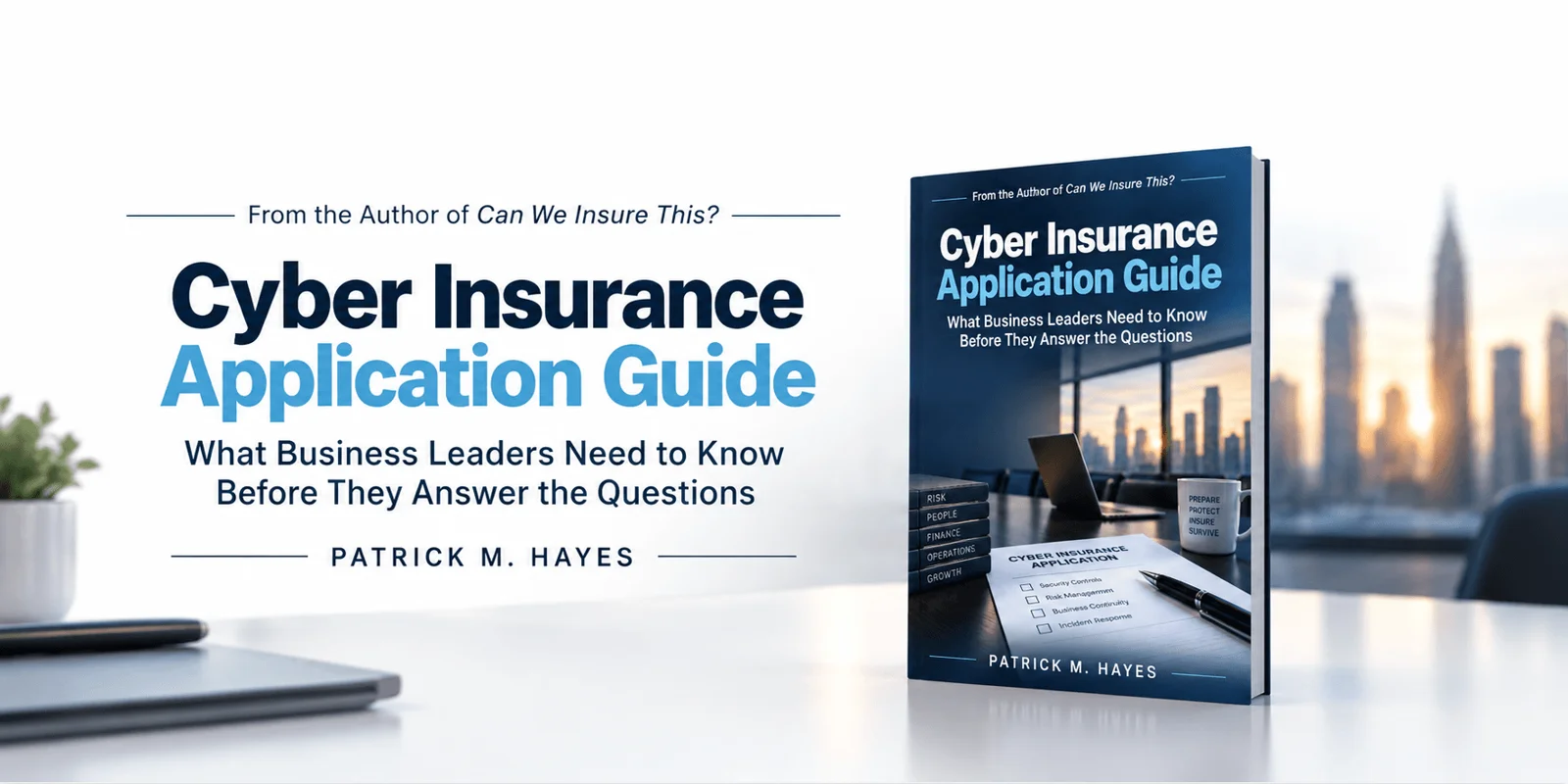
I wrote the Cyber Insurance Application Guide: What Business Leaders Need to Know Before They Answer the Questions because I think business leaders need a practical way to work through this process without having to become cybersecurity experts.
The guide walks through the areas that commonly appear on cyber insurance applications and explains what the insurer is trying to understand. It helps the person responsible for the application figure out where the answer probably exists inside the business and what kind of evidence can support it. More importantly, it gives leadership enough context to understand why the answer matters before someone signs the application.
Third Wave Innovations is making the guide available at no cost. That relationship makes sense because Third Wave works in several of the same areas insurers are asking businesses about, including Managed Detection and Response, security awareness training and phishing simulation, vulnerability and penetration testing, and Cyber Risk Protection. The goal is not to replace the company's IT team, MSP, broker, finance team, or other people involved in the process. It is to help businesses get a clearer picture of what is actually happening and make sure the answers being provided are based on something more than assumption.
The Application Can Tell You Something About Your Business
I have spent a lot of time writing about the difference between cybersecurity and business survivability. The cyber insurance application is another place where that difference becomes visible. A company can have plenty of security products and still discover that important controls are not operating the way leadership thought they were. It can have backups without knowing how long recovery will take. It can outsource IT without understanding exactly what the provider is responsible for. Those are business issues because they affect what happens when something goes wrong.
Cyber insurance has an important role in that picture. A serious cyber event can create costs that many businesses are not prepared to absorb as a normal operating expense. Depending on the policy, insurance can also provide access to specialized legal, forensic, incident response, notification, and other resources when the company needs them most. Insurance does not replace the work required to protect and prepare the business. It helps address the financial consequences that remain when those efforts are not enough.
That is why I think the application is worth taking seriously. Getting the policy renewed is obviously important, but the process can also show leadership where its understanding of the business does not match what can actually be demonstrated. When that happens, the application has done something useful before an incident ever occurs.
The Cyber Insurance Application Guide is available free, compliments of Third Wave Innovations. If you have a cyber insurance application or renewal coming up, I hope it helps you understand the questions before you answer them.