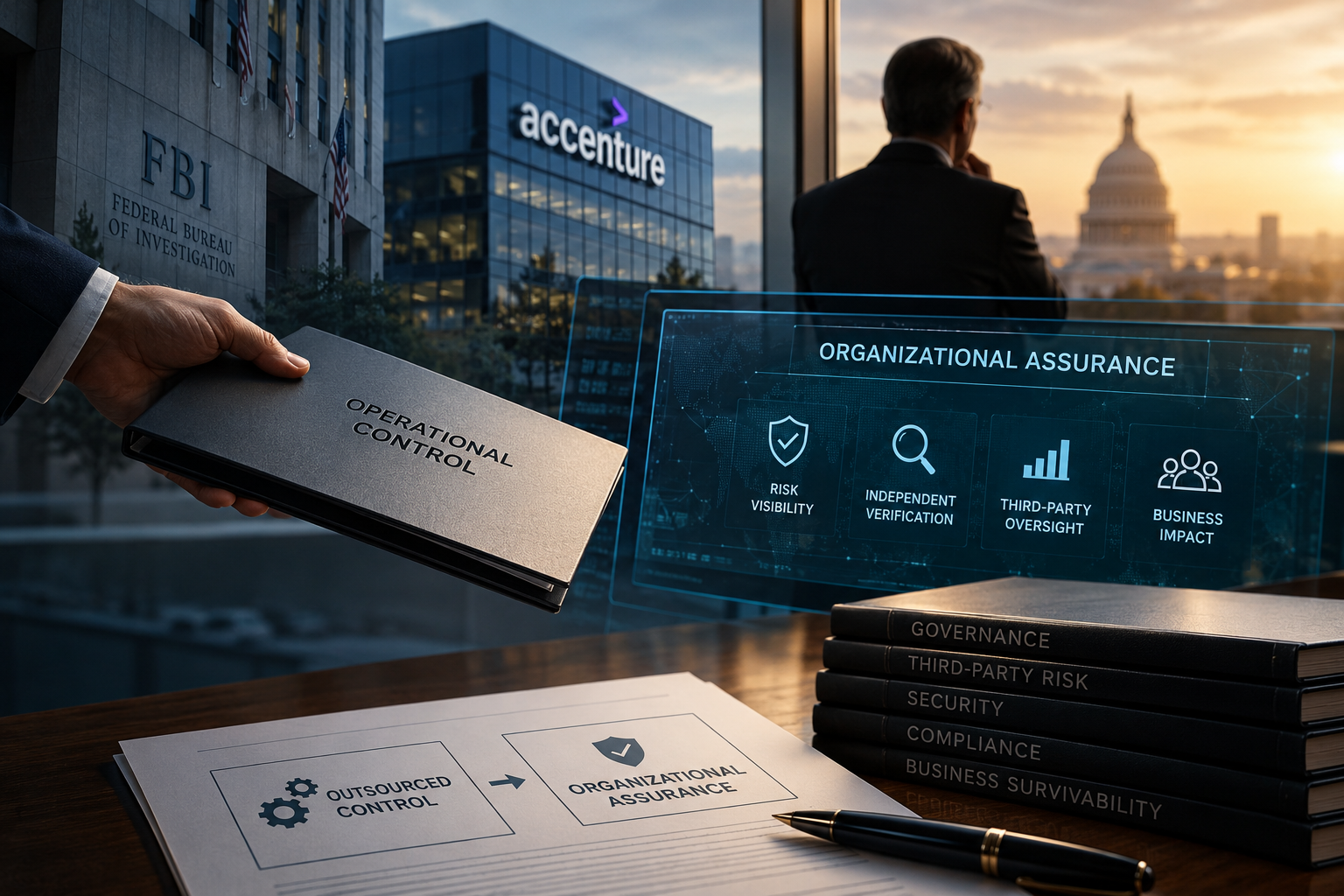
The recent cybersecurity incident involving the FBI and Accenture raises a question that organizations have struggled with for decades. When we assign responsibility for operating or securing part of our business to someone else, what responsibility do we retain for making sure that work is actually being performed? The distinction matters because outsourcing has become so deeply embedded in modern operations that many organizations no longer have direct control over some of the systems and services they depend upon most.
According to an October 6, 2026, Reuters report, the FBI removed an Accenture contractor following a cybersecurity incident involving sensitive personal information belonging to bureau employees. The FBI said the bureau's investigation identified a failure to implement an available security patch on a platform managed by a third party. Sources familiar with the incident identified the platform as Oracle PeopleSoft and the service provider as Accenture.
The consequences went well beyond the maintenance of an enterprise application. Reuters reported that compromised information included personal addresses, medical information, and details concerning employees involved in sensitive intelligence and counterintelligence activities. What might have begun as an ordinary patch-management responsibility therefore carried consequences that belonged very clearly to the FBI, regardless of who had been contracted to maintain the underlying system.
That is what makes this incident worth examining beyond the immediate question of whether a contractor failed to apply a patch. The more important issue is how an organization assures itself that a critical responsibility assigned to someone outside the organization is actually being performed to the level necessary to protect the business, its people, and its mission.
Attestation Is Not the Same as Assurance
Most organizations have developed some form of process for evaluating third-party service providers. They conduct security assessments and review certifications, while contracts establish requirements the provider is expected to meet. Depending on the relationship, the organization may also receive SOC reports, vulnerability information, audit results, or other evidence intended to demonstrate that security controls are operating.
All of that has value, but it can create a dangerous misunderstanding about what has actually been established. Third-party attestation provides evidence concerning the provider's practices, capabilities, or compliance with defined requirements. Organizational assurance requires the organization to determine whether the evidence available to it provides sufficient confidence that the conditions necessary to protect its operations are actually being maintained.
A provider may demonstrate that it operates a vulnerability management program and follows documented patch-management procedures. It may also show that people have been assigned responsibility for performing those activities. None of that necessarily establishes that a particular vulnerability affecting a critical system has been remediated.
The October 7 Nextgov/FCW report raises this issue directly. While the FBI attributed the incident to a contractor's failure to implement an available security patch, the reporting noted that the explanation did not establish why the patch had been missed or how the FBI monitored the contractor's work to ensure that the systems remained protected.
The publicly available reporting does not tell us what monitoring or independent verification the FBI had in place, so it would be unfair to conclude that those mechanisms did not exist. What the incident does demonstrate is the weakness in assuming that assigning responsibility for an operational control provides assurance that the condition the control is intended to maintain actually exists. Those are different questions, and organizations need to treat them that way.
When Contractual Responsibility Becomes an Operational Assumption
Outsourcing is a practical necessity for most organizations. Businesses use outside providers because those providers can offer specialized skills, technology, scale, or operational capabilities that would be difficult to reproduce internally. The problem develops when the assignment of contractual responsibility gradually becomes an operational assumption that the associated risk is being managed.
A contract can establish who is responsible for patching a system and how quickly vulnerabilities are expected to be remediated. It can establish reporting requirements and consequences when obligations are not fulfilled. What the contract cannot do is remove the vulnerability from the organization's environment when the work has not actually been performed.
That distinction is easy to lose in a complex organization. Procurement may see a contractual obligation, while third-party risk management sees an approved vendor and cybersecurity sees a provider with acceptable security documentation. The business sees a service that continues to operate. Unless those perspectives are connected, everyone can perform their assigned responsibilities while the underlying condition that matters to the organization remains unresolved.
According to Reuters, Oracle had issued a security alert and fixes were available following warnings about attacks targeting PeopleSoft environments. The FBI's review subsequently identified a failure to implement a security patch, although the complete sequence of decisions that resulted in the patch remaining unapplied has not been publicly established.
Enterprise patching is rarely as simple as installing an update the moment it becomes available. Systems may contain custom code and dependencies that require testing before changes can be introduced safely. That operational reality does not weaken the argument for assurance. It strengthens it because the organization needs to know when remediation has been delayed, understand why the exposure continues to exist, and determine whether the resulting risk remains acceptable.
Integrated Assurance and the Responsibility to Know
This is one of the reasons I developed Integrated Assurance as an operating model rather than another approach to security assessment or compliance. Organizations have spent decades creating separate functions responsible for cybersecurity, technology operations, enterprise risk, compliance, procurement, audit, and third-party management. Each function can perform its responsibilities effectively while still contributing only part of the information needed to understand the organization's actual exposure.
Third-party risk management might confirm that the provider supplied the required evidence, while cybersecurity operates a vulnerability management program covering the assets it controls directly. Technology operations may rely on the provider to maintain the outsourced environment, and business leadership may receive reports indicating that each of these functions is performing as expected. The difficulty appears when nobody has a complete view of whether a critical dependency is operating within the conditions the organization has decided are acceptable.
Integrated Assurance is intended to close that gap by connecting the activities responsible for managing risk with the operational conditions those activities are intended to maintain. When an important capability crosses an organizational boundary, assurance has to cross that boundary as well. The evidence produced by the provider becomes an input into the organization's understanding of risk rather than the final answer about whether the risk is being managed.
For a critical system, that could mean independently verifying the remediation of significant vulnerabilities or requiring evidence that a patch was actually deployed. When remediation cannot occur immediately, the organization may need visibility into the exception and the controls being used while the vulnerability remains. The amount of verification should depend on the importance of the system and the potential consequences if the control fails.
None of this requires an organization to recreate the service provider's operation internally. Doing so would undermine much of the reason for outsourcing in the first place. The organization instead needs enough visibility to understand the conditions upon which it is relying and enough authority to act when those conditions no longer support the level of trust originally placed in the provider.
Operational Trust Requires Current Evidence
The FBI incident also illustrates an important aspect of Operational Trust because trust in an operational environment cannot be established once and assumed to remain valid indefinitely. Organizations make decisions to rely on providers based on the information available at a particular point in time, but the conditions surrounding those decisions continue to change after the contract is signed.
New vulnerabilities are discovered and systems are modified as business requirements evolve. People responsible for operating those systems change, and the threat environment continues to develop. A provider that satisfied the organization's expectations when the relationship began can therefore encounter circumstances that require different controls or a different level of oversight later.
Operational Trust depends on having evidence that remains relevant to the organization's current exposure. A certification or assessment may provide useful evidence about a provider's overall security program, but it may tell the organization very little about whether a specific vulnerability affecting a system containing highly sensitive information was remediated last week.
Assurance should provide an opportunity to identify a deteriorating condition before the organization experiences the consequence. Discovering that a control failed after an incident tells us what happened, but it does very little to establish that the organization had an effective way of knowing whether the control was operating before the failure became visible.
Outsourcing Can Create Decision Debt
There is another aspect of this problem that connects directly to what I have described as Decision Debt. Every decision to outsource an operational capability contains assumptions about the provider's performance and the organization's ability to oversee the relationship. Those assumptions influence later decisions about internal staffing, technology investment, architecture, and the amount of knowledge the organization retains about the systems being operated on its behalf.
Over time, the organization may reduce internal capability because the provider has assumed responsibility for performing the work. Knowledge of the underlying technology may gradually move outside the organization, while reporting becomes increasingly dependent on information supplied by the provider. These can be reasonable consequences of a deliberate outsourcing strategy, but they also change the organization's ability to independently understand the conditions affecting its own risk.
Decision Debt begins to accumulate when the original decision remains in place while the assumptions supporting it are no longer regularly examined. The provider may still be meeting reporting requirements, and periodic assessments may continue to produce acceptable results, but the organization can gradually lose the ability to determine whether the operational reality still matches the assumptions upon which the relationship was built.
The resulting exposure may never appear as a failed audit or an obvious contractual violation. It can exist quietly in the difference between what the organization believes is being done and what it can actually demonstrate. The FBI reporting does not establish that this type of Decision Debt contributed to the incident, but the circumstances provide a useful example of why organizations should examine whether critical outsourced relationships have created dependencies they no longer have enough visibility to independently evaluate.
The Consequences Do Not Follow the Contract
The nature of the information reportedly affected by the FBI incident makes the accountability issue particularly clear. Nextgov/FCW reported concerns about information associated with personnel involved in sensitive intelligence activities, creating potential consequences that reached well beyond the operation of the PeopleSoft platform itself.
The contractor's assigned responsibility may have concerned maintaining a technology environment and applying security updates. The consequences associated with a failure belonged to the FBI because the people, information, and mission affected by the system remained the FBI's responsibility. No allocation of technical responsibility changes that basic relationship.
The same issue exists in commercial organizations, although the consequences take different forms. A manufacturer can outsource systems supporting production, and a healthcare organization can rely on a provider to operate an application containing patient information. A financial institution can place critical transaction services in the hands of an external technology provider. In each case, the provider can assume responsibility for operating the technology without assuming the full business consequence when that technology fails.
Contracts can provide remedies when a provider does not meet its obligations, but those remedies do not necessarily restore operations or recover information that has already been exposed. They cannot always repair customer relationships or reverse the consequences of a disruption that occurred at the wrong time. This is why third-party risk needs to be considered in terms of the business dependency being created rather than only the security characteristics of the provider.
What Organizational Assurance Should Actually Provide
The practical challenge is determining how much independent assurance an organization needs without creating an oversight structure so burdensome that it defeats the purpose of outsourcing. The answer should begin with the importance of the capability being provided and the consequences the organization would experience if the provider failed to perform as expected.
A relatively minor administrative service does not require the same level of assurance as a system supporting production or containing highly sensitive information. Organizations should understand those differences before determining what evidence they require from providers and what information they need to verify independently.
For critical services, assurance should extend beyond periodic assessments of the provider's overall security program. The organization needs evidence relevant to the actual conditions upon which it depends. In vulnerability management, that may require visibility into affected assets and remediation status, particularly when a vulnerability creates significant exposure to an important business capability.
When remediation is delayed, someone inside the organization needs enough information to understand why the exposure continues to exist and what it means to the business. The decision to accept that condition should occur at the appropriate level of authority rather than disappearing into routine vendor administration or remaining entirely within the provider's operational process.
Integrated Assurance brings those decisions into the organization's normal operating model by connecting the evidence generated by providers with the responsibilities of internal technology, cybersecurity, risk, and business leadership. The objective is not greater oversight for its own sake. It is having enough reliable information to know whether the conditions upon which the organization depends remain acceptable.
AI Will Make the Assurance Problem Harder
This gap between outsourced controls and organizational assurance will become more important as businesses introduce artificial intelligence into their operations. Many organizations are already adopting AI capabilities through existing software providers without making a separate decision to introduce AI at all. A feature appears in a product that has been used for years, and the nature of the organization's dependency begins to change even though the vendor relationship looks largely the same.
The provider may now process information differently or introduce automated decisions into a process that previously relied on people. Existing contracts and security assessments may not provide enough information to understand how those changes affect the organization because they were designed around a different operating model.
Traditional third-party assessments will remain useful, but organizations will need to determine whether the evidence they receive still addresses the conditions that matter to their own operations. When an AI-enabled service begins influencing decisions involving customers, employees, finances, or critical operations, relying solely on the provider's representation of its controls creates the same fundamental problem illustrated by the FBI incident.
The organization remains accountable for understanding what it has chosen to depend upon. As technology providers assume greater responsibility for operational decisions, the distance between organizational accountability and direct operational control will grow, making the quality of assurance increasingly important.
Business Survivability Depends on Understanding What You Trust
My work on Business Survivability has increasingly focused on dependencies because organizations rarely fail simply because one technical control did not operate as expected. Serious incidents tend to expose assumptions about how the business was expected to function and dependencies that were not fully understood until something stopped working.
Those weaknesses can remain hidden for years because normal operations provide very little reason to question them. The provider continues delivering the service and internal reports indicate that required processes are being followed. Leadership sees little reason to revisit a relationship that appears to be working, particularly when other parts of the organization have already determined that the provider meets established requirements.
An incident changes that understanding because it exposes the difference between the organization's expectation and the condition that actually existed. That is why the FBI and Accenture incident deserves attention beyond the missed patch itself. The public reporting describes a significant operational failure, but the larger question concerns how an organization maintains confidence in critical capabilities after responsibility for operating them has moved outside its direct control.
Business Survivability requires organizations to understand the conditions necessary to sustain operations and maintain enough assurance to know whether those conditions continue to exist. Outsourcing does not change that requirement. It changes where some of the evidence has to come from and how the organization establishes confidence in it.
Accountability Does Not End at the Contract
The FBI incident will understandably generate discussion about contractor performance, patch management, and the security obligations of government service providers. Those issues deserve scrutiny, particularly when the affected information may have implications extending beyond a conventional data breach. The larger lesson, however, should not be that organizations simply need stronger contracts or more third-party certifications.
Organizations need to understand the difference between evidence that a provider has established a control and assurance that the condition the organization depends upon is actually being maintained. Third-party attestations can contribute to that understanding, and contracts can establish responsibility for performing the work, but neither eliminates the organization's responsibility to determine whether its exposure remains acceptable.
Organizations are increasingly dependent on external technology providers and that responsibility becomes harder to fulfill because more of the information needed to understand risk originates outside the organization. Integrated Assurance provides a way to connect that evidence back to the business decisions that depend upon it so that outsourcing a capability does not also mean outsourcing the organization's ability to understand its own operating condition.
The lesson from the FBI incident is therefore broader than patch management and broader than Accenture. Outsourcing changes who performs a control, but it does not transfer the organization's responsibility for understanding whether the outcome of that control is sufficient to protect the business. That distinction is becoming increasingly important as third parties assume larger roles in technology operations and AI moves even more consequential activities outside the organization's direct control.