
Fragmented Defense in a Unified Ecosystem
The broadcast industry’s security model has historically been fragmented, divided along the same operational boundaries that once defined its organizational structure. Engineering managed transmission integrity, IT managed network operations, compliance monitored regulatory obligations, and editorial teams focused on production continuity. Each domain maintained its own controls, reports, and priorities. In the analog era, this segmentation created stability. In today’s digital ecosystem, it creates risk.
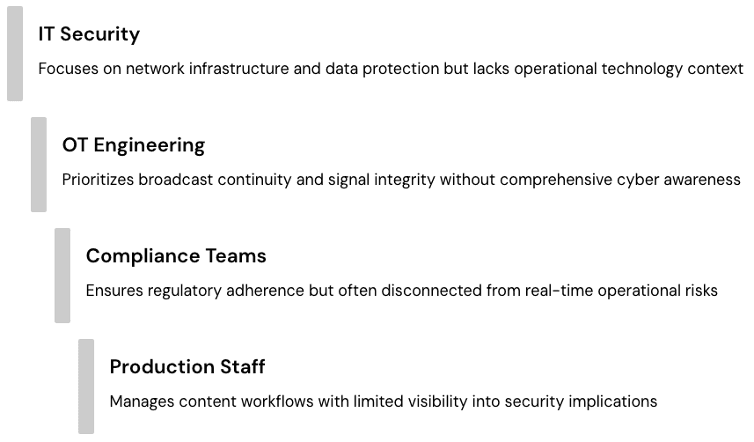 Adversaries exploit the seams between these functions. A weakness in a content management API can cascade into scheduling systems, propagate to transmission workflows, and compromise distribution feeds before detection occurs. Each department may respond within its domain, yet the cumulative result is delayed containment and unclear accountability. Compliance requirements may technically be met, but assurance, the organization’s demonstrated capacity to maintain trust and continuity under stress, remains uncertain.
Integrated Assurance addresses this structural vulnerability by unifying governance, engineering, and operations into a single, interconnected assurance model. It redefines cybersecurity not as a function, but as a behavior shared across disciplines. Within this model, every broadcast process becomes a verifiable component of resilience. Each domain contributes to assurance maturity, from leadership oversight to frontline telemetry.
The Integrated Assurance Maturity Model (IAMM) provides the structure for measuring and improving this unification. It distinguishes between compliance, which validates documentation, and assurance, which validates capability. Through IAMM, broadcast organizations can identify fragmentation points, align security responsibilities across teams, and create a governance fabric that evolves as rapidly as the technology it protects. The outcome is a defense model that operates as cohesively as the ecosystem it safeguards.
Incident Response and Business Continuity
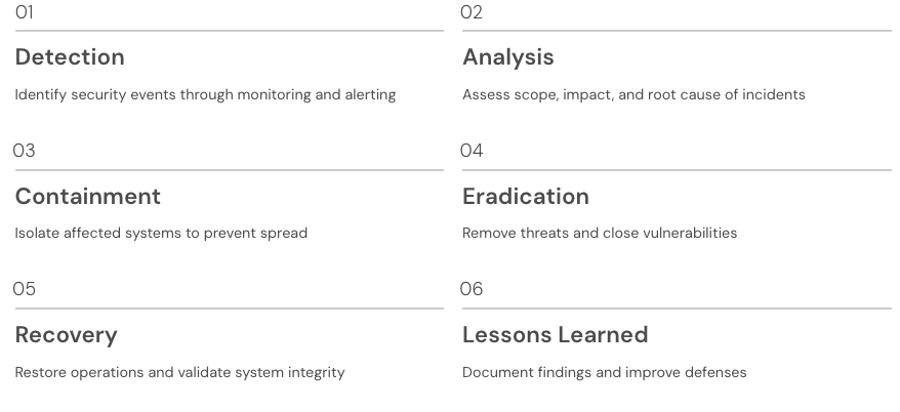
Effective incident response is fundamental to broadcast resilience. It ensures that organizations can detect, contain, and recover from cyber events without losing operational continuity. Because broadcasting is inherently real time, even brief interruptions can have public and financial consequences. A single outage can affect audiences, advertisers, and regulators simultaneously.
Incident response must therefore be both structured and adaptive. Plans should clearly define escalation paths, communication procedures, and decision-making authority. Teams must know who leads containment, who coordinates with external stakeholders, and who manages public communication. These roles should be tested regularly through simulations and refined based on lessons learned.
Automated detection and orchestration capabilities further strengthen response agility. Integrating Security Orchestration, Automation, and Response (SOAR) platforms with broadcast monitoring tools enables rapid isolation of compromised systems while maintaining essential transmission. Playbooks must also account for regulatory and legal obligations, ensuring that required notifications occur promptly and accurately.
 From Control to Confidence
Traditional cybersecurity strategies rely on controls such as policies, tools, and technical safeguards that define how systems should behave. While necessary, controls alone cannot sustain trust in dynamic, adaptive environments such as modern broadcasting. Controls are static; resilience requires adaptability. Confidence arises not from the existence of policies but from the demonstrated ability of the organization to perform under disruption.
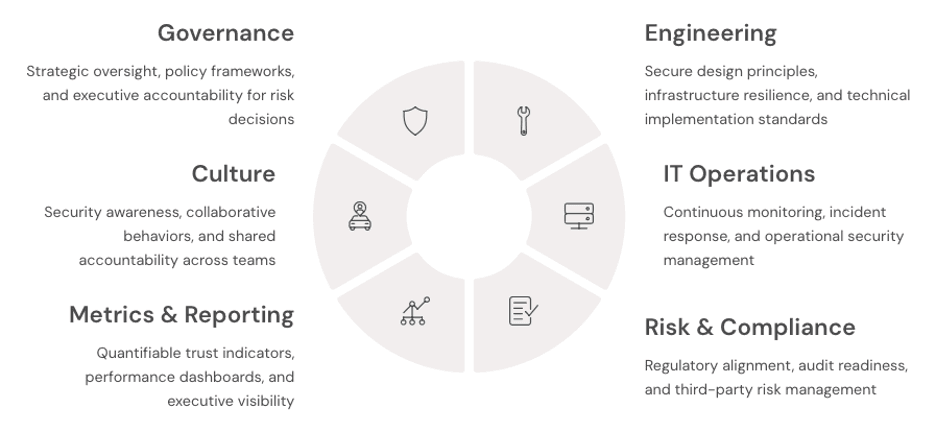 Integrated Assurance transforms control into confidence by embedding assurance functions across six interdependent domains: governance, architecture, operations, audit & risk management, metrics, and culture. Together, these domains form the structure through which organizations progress toward measurable trust. Governance establishes authority and accountability. Engineering ensures that design choices reflect security-by-default principles. Operations deliver monitoring and response at real time. Risk management aligns investments with business priorities. Metrics provide evidence of control performance, and culture sustains the human behaviors that make the entire system work.
This approach elevates cybersecurity from a technical discipline to a systemic one. When assurance is practiced continuously rather than periodically, the organization develops reflexive resilience and the ability to detect, respond, and recover with minimal impact to operations or credibility. Confidence, in this context, is not a subjective feeling but an auditable state of readiness validated through data. It is the assurance that systems will behave as intended even under stress, and that deviations will be detected and corrected before trust is compromised.
 IAMM operationalizes this progression by defining maturity levels that map to observable outcomes. At lower levels, assurance may exist as policy documentation or isolated technical audits. At higher levels, assurance becomes predictive, data-driven, and embedded in decision-making. For broadcasters, reaching these advanced stages means moving from reactive control to systemic confidence, where every process, from content creation to playout, contributes to the measurable preservation of trust.
Trust by Design for AI-Driven Media
Artificial intelligence now sits at the core of modern broadcast operations. It schedules programming, assists in content editing, manages advertising insertion, and drives recommendation engines that personalize audience experiences. These functions create efficiency and innovation, yet they also redefine accountability. When AI systems influence what audiences see and how content flows, trust can no longer be assumed. It must be designed, verified, and maintained.
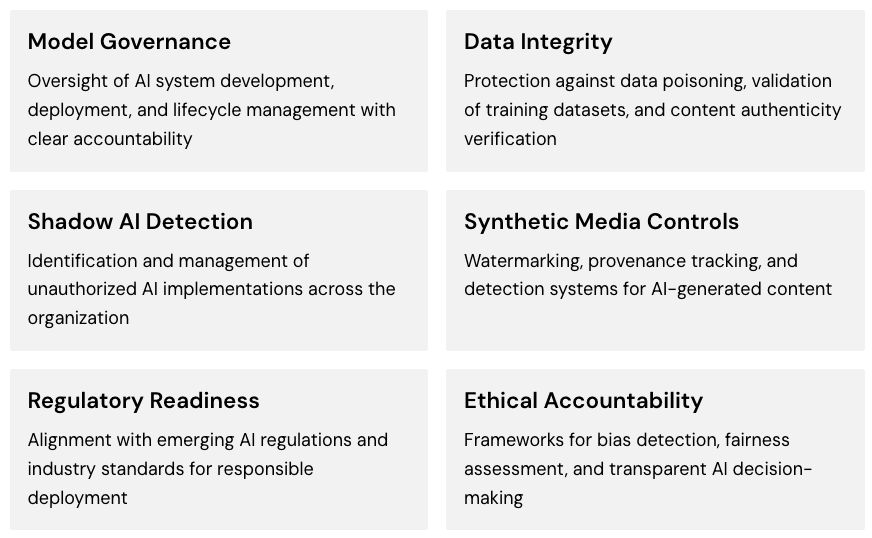
The AI-Integrated Assurance Maturity Model (AI-IAMM) extends the foundational IAMM framework to address this new operational reality. It establishes the principles by which AI can be governed responsibly within the broadcast enterprise. The model introduces three key dimensions of AI assurance: transparency, integrity, and accountability. Transparency ensures that AI decisions can be understood and traced to their inputs. Integrity ensures that data and models remain free from manipulation. Accountability ensures that human oversight remains present and enforceable even when systems act autonomously.
AI-IAMM maturity progresses through stages that parallel traditional assurance evolution. Early stages emphasize documentation of models and training data. Intermediate stages focus on implementing validation mechanisms that test for bias, drift, and adversarial manipulation. Advanced stages achieve real-time auditability and continuous verification, where AI decisions are monitored and corrected autonomously within defined governance limits. This progression provides a roadmap for broadcasters to adopt AI confidently, knowing that their systems remain auditable and aligned with ethical and operational objectives.
 Trust by design in AI-driven media means embedding assurance at every layer of system architecture. Model deployment pipelines must include integrity validation. Decision logs must capture context for post-event review. Monitoring systems must identify anomalous model behavior as quickly as they identify network anomalies. By extending traditional cybersecurity principles to AI systems, broadcasters transform artificial intelligence from a risk amplifier into a governed asset and a source of operational trust rather than uncertainty.
Integrated Assurance and AI-IAMM together redefine resilience in the modern broadcast enterprise. They shift the organization’s focus from preventing failure to sustaining integrity, from enforcing compliance to demonstrating confidence. In an era where audiences must trust both the message and the mechanism that delivers it, trust by design becomes the highest form of security architecture.