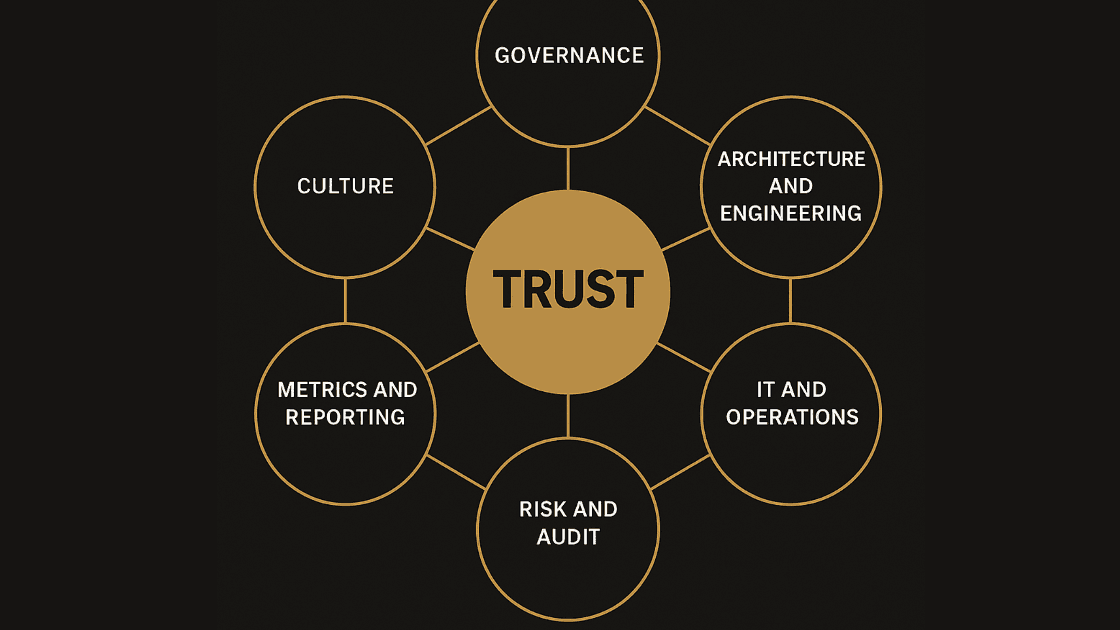
Overview of IAMM
AI cannot be managed by traditional security or compliance models alone. Its behavior shifts with data, its risks appear across the entire lifecycle, and its outcomes influence stakeholders far beyond IT. To govern AI effectively, organizations require a structure that unifies security, risk, operations, engineering, and culture into one coherent approach. The Integrated Assurance Maturity Model, or IAMM, was developed to provide that structure.
IAMM is not another framework that sits alongside existing standards. It is a connective model that integrates governance, risk, and assurance across the enterprise. For AI, IAMM ensures that assurance is not a siloed responsibility but an organizational discipline embedded into decision-making, engineering processes, and cultural expectations. The model creates a pathway for enterprises to measure their current state, identify maturity gaps, and advance toward institutionalized trust.
The Six Domains of IAMM
The IAMM framework is built on six domains that together create a complete picture of assurance. Each domain addresses a distinct but interdependent set of responsibilities.
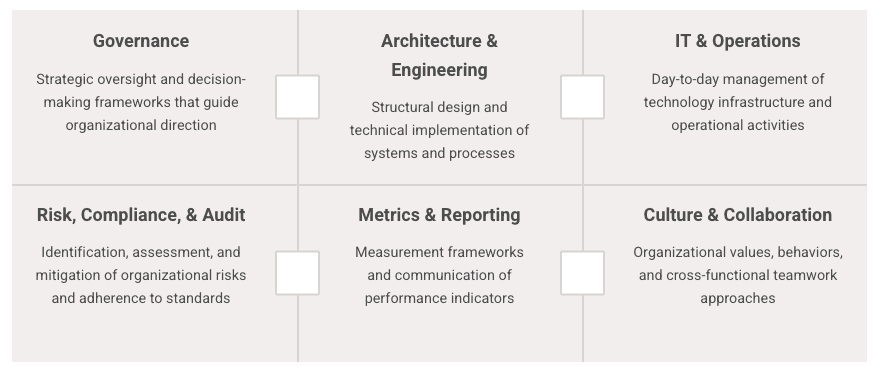 1. Governance: AI requires more than policy documents or oversight committees. Governance in the IAMM context ensures that accountability is visible and enforceable at the highest levels. Boards and executive teams must have visibility into AI use, risk exposure, and assurance practices. Within AI, this includes subdomains such as model governance, interface security, and human oversight. Policies must be more than statements. They must be tied to mechanisms that control access, enforce escalation, and assign responsibility.
2. Architecture and Engineering: Secure design begins at the technical foundation. For AI, this means embedding assurance into model design, training pipelines, and deployment architectures. Data integrity and provenance must be tracked throughout the lifecycle. Models cannot be trained on datasets of unknown origin or questionable quality. Assurance requires version control, reproducibility, and continuous validation. Engineering teams must also embed resilience into interfaces, ensuring protections against adversarial prompts, model inversion, and other threats unique to AI.
3. IT and Operations: The adoption of AI has already outpaced formal controls in many enterprises. Employees experiment with public tools, integrate unapproved services, and handle sensitive data outside governance. This phenomenon, often called shadow AI, introduces unmanaged risk. IAMM requires operational oversight that detects and addresses this behavior. Safe, sanctioned platforms must be provided as alternatives, and enterprise registries of AI systems must be maintained. Operations also extend to continuous monitoring, telemetry, and anomaly detection, ensuring that AI systems remain within trusted parameters over time.
4. Risk, Compliance, and Audit: AI is already subject to regulatory attention, and more laws are arriving. The EU AI Act, U.S. executive orders, and sector-specific guidelines set clear expectations for transparency, oversight, and documentation. Enterprises cannot wait for regulations to mature. They must embed compliance readiness into their AI lifecycle now. Risk and audit functions must verify synthetic media detection, document compliance controls, and ensure that AI adoption aligns with legal and ethical standards. Assurance in this domain transforms compliance from a reactive task into a strategic capability.
5. Metrics and Reporting: AI cannot be trusted if success is measured only in terms of accuracy or throughput. Assurance requires metrics that capture fairness, explainability, resilience, and ethical alignment. IAMM directs organizations to build dashboards that present trust-related indicators alongside performance data. Drift detection, bias monitoring, explainability scores, and trust velocity become as important as speed or cost savings. These metrics must be shared across functions and reported at board level. Without them, leaders are operating blind.
6. Culture and Collaboration: No enterprise can govern AI through controls alone. Culture determines whether teams respect oversight, raise concerns, or cut corners. IAMM embeds ethical accountability into organizational culture. Ethical review boards, fairness audits, and trust KPIs ensure that decisions reflect more than performance goals. Collaboration across legal, compliance, engineering, and business units becomes routine rather than exceptional. By institutionalizing cultural accountability, IAMM ensures that trust is not assumed but continuously reinforced.
Maturity Levels Applied to AI
IAMM defines five maturity levels that allow enterprises to benchmark their capabilities and chart a path forward. Each level reflects the degree to which assurance is integrated into AI adoption.
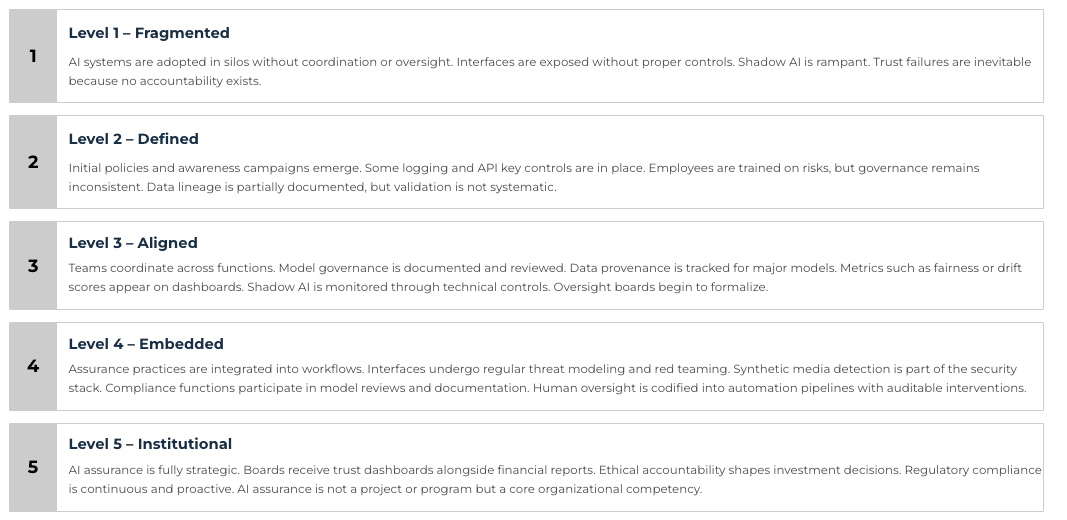 This maturity journey allows enterprises to evaluate their current position honestly and move forward with a structured plan.
Uneven Maturity Across Domains
Progress through the IAMM levels is rarely uniform. An enterprise may excel in one domain while lagging in another. This unevenness is not a sign of failure. It is a reflection of how organizations prioritize investments, how culture adapts, and how external pressures such as regulation or customer demand drive focus. The value of IAMM lies in acknowledging this reality and providing a structure to address it deliberately.
Consider governance. A board may establish oversight committees, approve AI policies, and set accountability at Level 3 or Level 4. Yet the same enterprise may lack engineering practices that ensure model reproducibility, provenance tracking, or continuous validation. The result is governance that appears strong but is disconnected from technical assurance.
Another enterprise may advance its engineering controls rapidly. Development teams may implement automated validation, integrate adversarial testing, and adopt explainability thresholds that place them at Level 4 maturity. At the same time, culture may remain at Level 2. Employees may cut corners, use shadow AI tools, or dismiss oversight as a distraction. The lack of cultural accountability creates cracks that technical strength cannot seal.
Uneven maturity is also visible in operations. A financial services firm may maintain a registry of AI systems and monitor shadow AI effectively, placing operations at Level 3 or higher. Yet risk and compliance may still be reactive. Documentation may be incomplete. Alignment with emerging regulations such as the EU AI Act or U.S. executive orders may not exist. In this case, regulators and auditors see gaps even when operational teams believe they are ahead.
Metrics and reporting often lag behind other domains. Many organizations focus first on governance, engineering, and compliance, leaving metrics as an afterthought. Dashboards may show performance but not fairness or explainability. Drift detection may be absent, leaving assurance incomplete. Without mature metrics, executives and boards cannot see assurance performance in real time. This creates blind spots that undermine confidence.
IAMM provides a way to visualize these gaps. Maturity assessments should not only assign a level per domain but also highlight divergence. A radar chart or maturity map shows whether one domain is advanced while another remains fragmented. This transparency helps leaders avoid the false sense of security that comes from celebrating isolated progress.
Closing unevenness requires intentional remediation. Enterprises must identify the domains where maturity lags and invest in raising them. This may involve allocating resources, training, or leadership attention to areas that receive less focus. For example, a firm with strong engineering but weak culture may prioritize ethics training, employee engagement, and accountability mechanisms. A company with strong governance but weak metrics may invest in dashboards, explainability tools, and bias monitoring.
The goal is not perfect balance at all times but conscious progress. Uneven maturity is a temporary state when managed deliberately. It becomes a long-term liability only when ignored. IAMM allows organizations to move at different speeds across domains while maintaining visibility into where reinforcement is needed.
In practice, the enterprises that succeed are those that accept uneven maturity as normal yet temporary. They communicate clearly where strengths exist, where weaknesses remain, and how the journey continues. They avoid complacency in advanced domains and neglect in weaker ones. By recognizing unevenness as part of the maturity process, they sustain progress and reduce systemic risk.
Alignment with Existing Standards
The Integrated Assurance Maturity Model was not created to compete with established frameworks. Its role is to turn them into practical disciplines that work across the full lifecycle of artificial intelligence. Many organizations already rely on standards such as NIST CSF, ISO, COBIT, or COSO, and they should not abandon those foundations. What IAMM provides is the connective structure that allows those frameworks to move from policy statements and control catalogs into daily practice.
The NIST Cybersecurity Framework 2.0 defines governance functions and core security activities. IAMM builds on this by extending those functions into continuous monitoring of AI-specific risks. The periodic assessments that NIST encourages become living processes when mapped through IAMM, ensuring that model drift, adversarial threats, and interface exposures are tracked in real time.
ISO/IEC 42001 establishes the requirements for AI management systems. It provides a regulatory scaffolding that can guide responsible adoption. IAMM takes those requirements and embeds them into engineering and operations. Where ISO sets the “what,” IAMM defines the “how.” It ensures that provenance tracking, data validation, and human oversight are not only written into policy but also engineered into pipelines and workflows.
COBIT and COSO ERM define governance and enterprise risk management at a high level. Their principles shape how organizations establish accountability and align risk with strategy. IAMM makes those principles tangible in the AI context. It connects governance decisions to technical assurance and ensures that cultural accountability is reinforced at every level of adoption.
MITRE ATT&CK identifies how adversaries operate. It catalogues tactics and techniques that shape defense planning. IAMM translates those adversary behaviors into organizational countermeasures. It ensures that protections exist not only at the technical interface but also within governance, data integrity, and cultural oversight.
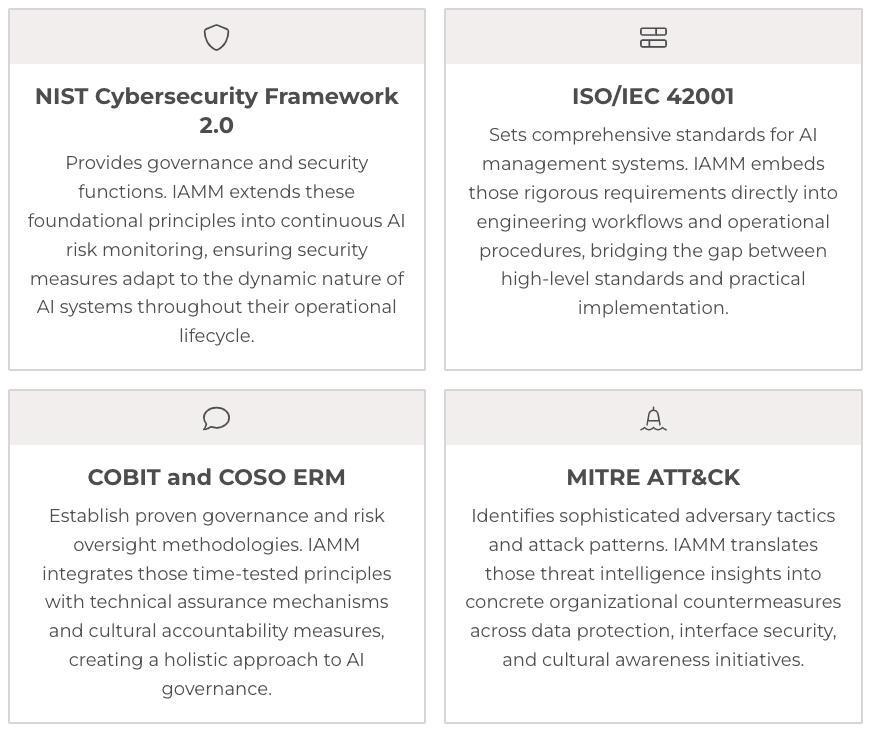 Through this alignment, enterprises can adopt IAMM while preserving the value of the frameworks already in place. IAMM does not require leaders to choose one model over another. It binds them together, filling the operational gaps where siloed approaches have traditionally fallen short.
Why IAMM Matters for AI
Enterprises cannot rely on isolated measures of success when deploying AI. Accuracy rates, performance benchmarks, and cost savings do not reveal whether a model is biased, whether data is trustworthy, or whether outputs can withstand regulatory scrutiny. Without integrated assurance, AI becomes a liability rather than an asset.
IAMM matters because it treats assurance as the foundation of trust. It turns fragmented oversight into a measurable, strategic discipline. It forces organizations to recognize that AI risks cut across governance, engineering, operations, and culture simultaneously. By defining maturity levels, IAMM also provides leaders with a roadmap. Progress can be measured. Gaps can be closed. Trust can be institutionalized.
AI adoption without assurance is reckless. Enterprises that fail to govern AI risk undermining their own credibility, facing regulatory penalties, and losing customer trust. The Integrated Assurance Maturity Model offers a path to prevent these outcomes. It embeds governance, engineering, operations, compliance, metrics, and culture into one unified discipline.
Applied to AI, IAMM ensures that assurance is not reactive but continuous. It transforms compliance from a checklist into a strategic advantage. It makes trust measurable, accountability enforceable, and resilience sustainable. As AI continues to expand across industries, IAMM positions enterprises to innovate with confidence while safeguarding the trust of their stakeholders.