
From Media Networks to Digital Ecosystems
Broadcasting has undergone a transformation more profound than any in its century-long history. Once governed by closed transmission networks and controlled production pipelines, the modern broadcast enterprise now operates as an interconnected digital ecosystem. Cloud-based playout systems, remote production environments, IP signal transport, and AI-driven editing suites have replaced the predictable architectures of the analog era. These advancements have expanded creative capacity but also redefined exposure, introducing a security surface that extends across every endpoint, vendor, and network exchange.
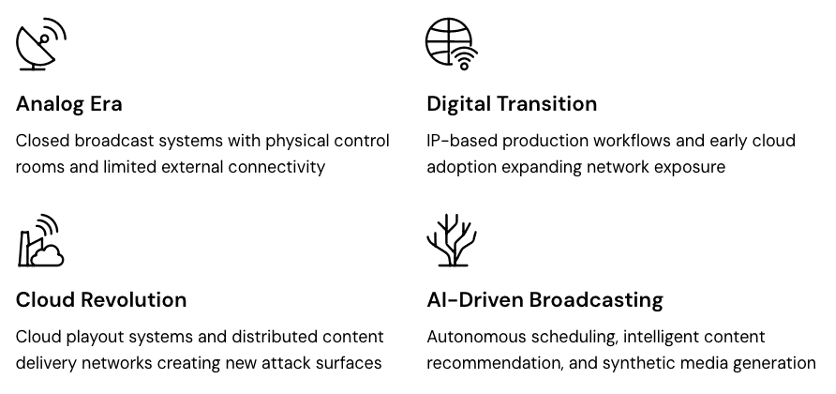 Each system, whether for ingest, transcoding, or content management, now forms part of a distributed cyber-physical infrastructure. This ecosystem thrives on interoperability, yet that very interconnectivity exposes the industry to cascading risks. A single misconfigured API compromised remote workstation, or unpatched cloud dependency can interrupt live broadcast operations and spread laterally across multiple business units. Legacy assumptions of segmentation no longer hold true; control rooms, cloud infrastructure, and consumer devices now share common digital dependencies.
The shift from linear media networks to dynamic, data-driven ecosystems requires a new model of governance and assurance. Security in isolation cannot manage what is, by design, an environment of convergence. A unified, cross-domain approach that synchronizes technology, policy, and culture which is necessary to sustain both creative agility and operational resilience. Only by treating the broadcast operation as a living digital organism, continuously monitored and governed as a whole, can organizations protect the trust embedded in their signal paths.
When Every Pixel Becomes a Target
Every element within the broadcast chai, every pixel, metadata packet, and content stream, has become a potential vector of exploitation. The modern broadcast environment represents a fusion of IT infrastructure, operational technology, and artificial intelligence. While this convergence enables extraordinary levels of automation, it also introduces compound vulnerabilities that traditional controls were never designed to address.
Threat actors no longer need to compromise an entire network to inflict damage. They can manipulate a feed in transit, insert synthetic overlays, or alter file metadata to affect downstream systems. The blending of data pipelines, production automation, and digital content delivery allows subtle manipulation to occur far earlier in the workflow than most monitoring systems can detect. The attack surface has expanded beyond transmission equipment and network nodes to include creative tools, scheduling algorithms, and even the AI models that govern real-time decision-making.
AI-assisted attacks now operate at unprecedented speed and precision. Techniques such as prompt injection, model poisoning, and synthetic data manipulation can be executed autonomously, enabling adversaries to distort or replace authentic content without triggering conventional alerts. These manipulations are not designed to destroy infrastructure; they are engineered to erode credibility. In an industry where perception defines value, the contamination of authenticity represents the highest form of breach.
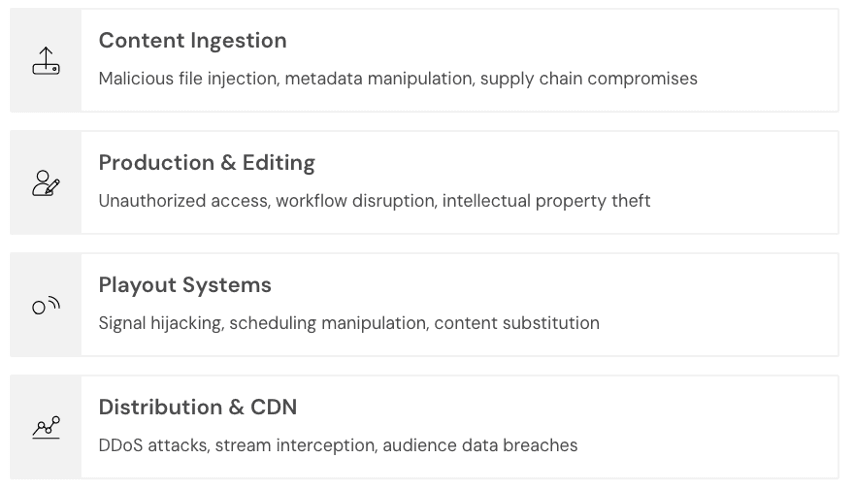 Defending this new threat space requires an operational mindset that shifts from system availability to content integrity. Authenticity verification, model validation, and provenance tracking must become core components of broadcast assurance. Protection is no longer achieved through perimeter control but through continuous, system-wide validation that ensures what is seen and heard by the audience remains genuine and unaltered.
Synthetic Media and the Collapse of Authenticity
 The rise of synthetic media marks a decisive turning point in the relationship between technology, truth, and audience trust. Artificial intelligence now enables the rapid creation of hyper-realistic content such as deepfakes, cloned voices, and fabricated narratives, that are indistinguishable from genuine broadcasts. These tools have evolved from experimental curiosities into operational instruments of manipulation. For the broadcast industry, which trades on credibility and verification, the threat is profound.
Authenticity once relied on control of the production process and the credibility of the source. Today, both can be simulated with precision. A convincing deepfake of a public figure, an artificially generated interview, or an edited news sequence can reach millions before validation occurs. When audiences can no longer distinguish authentic broadcasts from fabricated ones, the social contract between media institutions and the public fractures. Trust, once broken, is far more difficult to restore than technology is to rebuild.
Addressing synthetic media risk demands an architectural rather than reactive response. Verification must be built into the broadcast process from content creation to final playout. Provenance tagging, watermarking, and cryptographic validation should operate automatically within production and distribution workflows. AI-based authenticity detection can assist in identifying manipulated segments, but without integration into operational governance, these tools remain isolated safeguards rather than systemic defenses.
Maintaining credibility in an era of synthetic content requires both technological and organizational evolution. Broadcasters must treat authenticity as a measurable performance indicator as critical as uptime or latency. Resilience now depends on the ability to verify truth in real time, embedding the assurance of integrity as a core feature of the broadcast enterprise rather than an afterthought.