
Autonomous Threats in the Broadcast Kill Chain
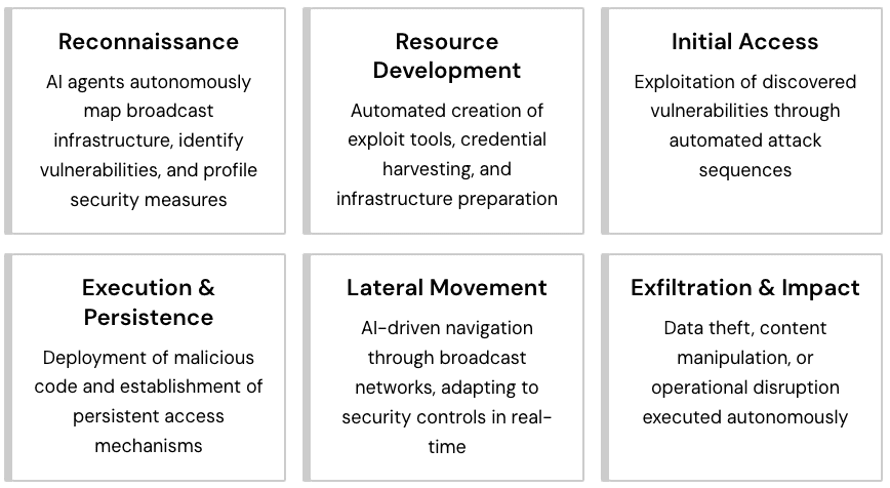
Artificial intelligence has not only transformed broadcasting but also redefined how threats manifest and evolve within it. The broadcast kill chain, once linear and dependent on human initiative, now includes autonomous agents capable of reconnaissance, infiltration, and adaptation at speeds beyond human response. These systems learn in motion. They map broadcast networks, analyze workflows, and identify control interfaces by observing operational telemetry in real time.
Unlike traditional cyberattacks that depend on pre-programmed scripts or manual exploitation, agentic threats operate continuously. They iterate, adjust, and refine tactics as they encounter resistance. When a defensive control blocks one vector, the system evaluates alternative paths automatically, using statistical feedback to improve its next attempt. This self-directed behavior transforms the broadcast environment into a living contest between automated attack and automated defense.
Such capabilities shift the threat model from static breach prevention to dynamic containment and resilience. Autonomous adversaries can identify patterns in playout scheduling, decode control logic within media automation systems, and exploit temporal synchronization across broadcast assets. They can also coordinate with other malicious agents distributed across global infrastructure, forming digital ecosystems of attack. The result is a form of intelligent persistence that no longer needs to compromise a single device to achieve disruption; instead, it manipulates system behavior, timing, and authenticity to erode confidence at scale.
Responding to this evolution requires parity of intelligence. Human oversight alone cannot defend at the required velocity or volume. Broadcast organizations must implement defensive AI that learns, adapts, and responds at machine speed. This includes behavioral analytics capable of modeling expected workflow patterns, anomaly detection engines that distinguish legitimate automation from malicious mimicry, and orchestration systems that execute isolation and recovery autonomously. Assurance in this context becomes not a static policy but a living defense posture that is validated continuously and governed by principles of transparency, accountability, and traceable decision logic.
 Resilience in the Era of Agentic Systems
The emergence of agentic systems marks a fundamental change in how broadcasting organizations must conceive of security, resilience, and assurance. These systems possess varying degrees of autonomy, enabling them to perform decision-making tasks once reserved for human operators. Automated editing, intelligent ad-insertion, real-time moderation, and network optimization are now managed by algorithms that interpret data and act upon it without direct supervision. This efficiency enhances production velocity but also introduces an asymmetry of control.
Agentic systems can fail or be manipulated at the same speed they operate. When decision authority shifts from human operators to algorithms, accountability must follow. Without mechanisms for oversight, transparency, and intervention, organizations risk surrendering control to processes they cannot fully explain. Assurance in this environment means ensuring that every autonomous decision remains traceable, reversible, and governed by enforceable policy boundaries.
Research presented in AI as a Threat Vector demonstrates that static controls and scheduled reviews are inadequate for managing adaptive AI behaviors. Broadcast organizations must establish governance frameworks capable of observing AI activity continuously and validating its compliance with defined operational intent. These frameworks should integrate model observability, behavioral baselining, and anomaly escalation to human oversight when deviations occur. In essence, the system must be designed to recognize when its own autonomy exceeds acceptable thresholds.
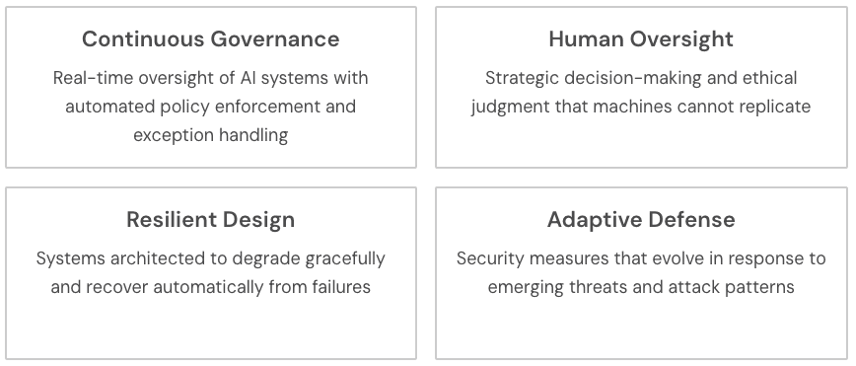 This approach aligns closely with emerging international standards such as the EU AI Act, NIST AI Risk Management Framework, and ISO/IEC 42001. Each of these frameworks emphasizes traceability, explainability, and risk proportionality as prerequisites for trustworthy AI. Integrated Assurance extends these principles into the broadcast domain, embedding governance directly within AI-enabled workflows rather than applying it after deployment. The result is a model where performance, compliance, and ethical responsibility coexist within a single operational fabric.
Resilience in the age of agentic systems is achieved not by eliminating automation but by governing it intelligently. Organizations that integrate assurance at the design phase of AI adoption gain the ability to innovate confidently, knowing that control and transparency evolve in parallel with capability. In broadcasting, where public trust defines brand survival, this balance between autonomy and accountability is the new frontier of cybersecurity maturity.