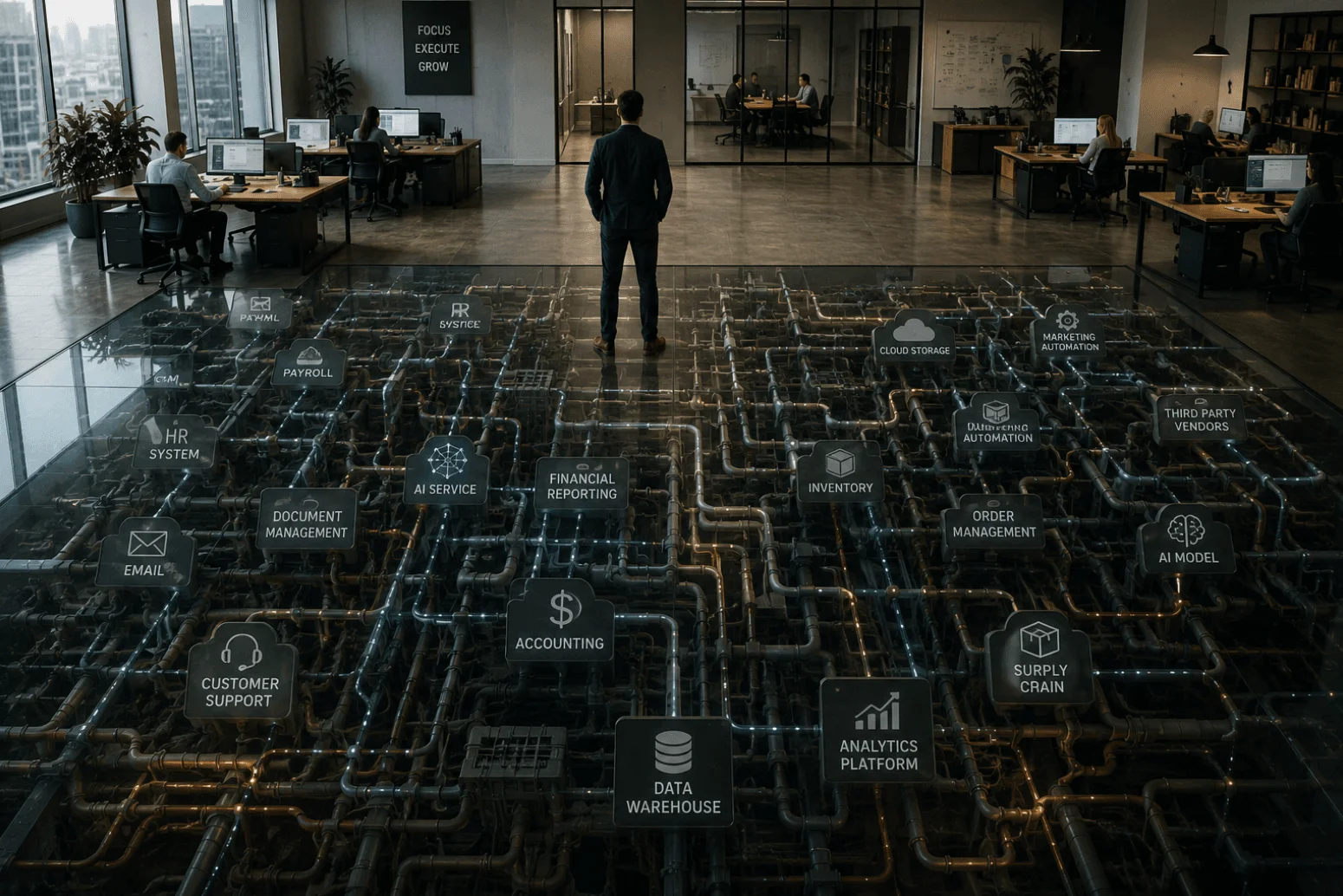
One of the greatest advantages of owning a business is that you understand almost everything that happens inside it. In the early days, nothing escapes your attention for very long. You know which customers pay on time and which ones need reminders. You know who can solve a problem in five minutes and who needs more direction. If an order is delayed, you probably know why before anyone else does. When an employee has a question, they come directly to you because you're the one who built the process in the first place. That level of visibility isn't just comforting. It's one of the reasons small businesses can move faster than much larger competitors.
As the business grows, that visibility naturally begins to fade, because growth requires trust. You hire people with expertise you don't have. You give managers authority to make decisions. You outsource payroll because it no longer makes sense to do it yourself. Your accountant recommends new software. Your IT provider implements systems that make the business more efficient. Vendors introduce new capabilities that save time. Every one of those decisions allows the business to scale, and every one of them also moves a little more knowledge away from the owner.
The transition happens so gradually that it's almost impossible to notice while you're living through it. The business continues operating, customers remain happy, revenue increases, and the problems you're solving become different from the ones you faced when you first opened your doors. Instead of worrying about landing your next customer, you're thinking about hiring, cash flow, growth, or expansion into another market. It feels like progress because it is progress. At the same time, the company you've built begins evolving into something far more complex than the business you remember.
Eventually there comes a point where no single person understands how everything works anymore. The owner understands the vision. Department leaders understand their teams. Outside vendors understand the services they provide. Your accountant understands the financials. Your IT provider understands the technology. Everyone has a piece of the picture, but nobody has the whole picture. That isn't a failure of leadership. It's simply the reality of a growing business. The danger is assuming you still have the same level of visibility you had when there were ten employees instead of one hundred.
Success Can Hide Problems
I've found that most businesses don't lose sight of how they operate because someone made a bad decision. They lose sight of it because the business keeps succeeding. Customers are served, payroll gets processed, invoices go out, and another month comes to an end. When nothing appears broken, nobody spends much time asking how all of those things actually happened. The assumption is that because the business is running, everyone understands how it runs. In my experience, that's often where the biggest surprises are waiting.
What owners don't always see is that their employees are constantly adapting. Someone builds a spreadsheet because the software can't produce the report management wants. A customer service representative develops a manual process that saves twenty minutes every day. Operations creates a workaround because integrating two systems would cost too much. Sales begins relying on a cloud application that was never part of the original technology plan because it helps close business faster. None of these decisions are malicious. Most are examples of employees trying to make the company more productive.
Over time those temporary solutions stop feeling temporary. New employees are trained on them as though they've always existed. Managers begin making decisions based on reports that originate from spreadsheets nobody remembers creating. Entire business processes become dependent on knowledge that lives with one employee or one department. The workaround quietly becomes the process.
That is why I've always been more interested in understanding how a business actually operates than how it appears to operate on paper. Policies, process diagrams, and organizational charts all have value, but they rarely tell the complete story. The real business lives in the decisions people make every day, especially the ones nobody documents because they seem too ordinary to matter.
AI Is Accelerating the Change
AI isn't the disruption most people imagine. For many businesses, it doesn't arrive through a major transformation project. It arrives through the tools they already trust. New features appear, employees naturally begin using them, and work gradually changes. Months later, the business is operating differently than it was before, yet nobody can point to the day everything changed..
Each new feature saves a little time. Employees naturally begin relying on those recommendations because they are usually good enough. Over weeks and months, small decisions that once required human judgment become automated without anyone consciously deciding to change the way the business operates. Productivity improves, which reinforces the idea that everything is moving in the right direction.
The challenge is that understanding gradually becomes separated from execution. People become comfortable accepting recommendations without knowing how they were generated. Managers begin trusting summaries instead of reading the underlying information. Business processes continue functioning, but fewer people can explain how decisions are actually being made. That loss of understanding doesn't happen overnight. It accumulates quietly until the business reaches a point where nobody can clearly describe what depends on what anymore.
For a business owner, that matters because survivability depends on understanding dependencies. If customer data moves through three different AI-enabled applications before reaching your accounting system, you should understand that relationship. If automated workflows determine how orders are processed or how customer requests are prioritized, you should know where those decisions originate. None of this requires becoming an AI expert. It simply requires remaining connected to how your business creates value.
Survivability Starts Long Before an Incident
One of the biggest misconceptions I encounter is the belief that survivability begins when something goes wrong. By the time a cyber-attack, system outage, or operational failure occurs, most of the important decisions have already been made. The outcome is often determined by choices the business made months or years earlier about technology, vendors, documentation, staffing, and operational priorities.
When I work with organizations after an incident, the technical problem is usually only part of the conversation. The more difficult challenge is understanding how the disruption affects customer communication, production, purchasing, cash flow, regulatory obligations, and vendor relationships. Those aren't cybersecurity problems. They're business problems. They only become visible because a technical event forced everyone to examine how work actually gets done.
The businesses that recover most effectively are usually the ones that understand themselves. Leadership knows which systems are truly critical because they've taken the time to think through the consequences of losing them. They know which vendors need to be contacted first, which employees can make operational decisions, and how to continue serving customers while systems are being restored. Recovery feels coordinated because understanding existed before the disruption began.
That level of understanding doesn't come from an annual exercise or a compliance requirement. It comes from leaders who remain curious about their own business as it evolves. They recognize that growth changes the organization and they periodically step back to ask whether yesterday's assumptions are still true.
A Different Conversation for Business Owners
For years the conversation around cybersecurity has centered on preventing attacks. More recently it has shifted toward AI, regulations, cyber insurance, and the latest security technologies. Those conversations have their place, but they often leave business owners believing that resilience is something they purchase rather than something they build.
I don't think survivability begins with another product or another framework. I think it begins with understanding. Understanding how money flows through the business. Understanding which relationships create value for customers. Understanding where decisions are made, how information moves, and what happens if one piece of the organization suddenly becomes unavailable. Those questions don't belong to the IT department. They belong to every owner who wants to build a company that can withstand disruption.
Technology will continue changing. AI will become part of almost every application your business uses. Your employees will continue finding better ways to solve problems, and your vendors will continue introducing capabilities that promise greater efficiency. None of those trends concern me nearly as much as the possibility that business owners slowly lose sight of how their own companies actually operate.
Growth changes every organization. The owners who continue asking questions long after everyone else assumes they know the answers will be the ones most prepared when disruption eventually arrives.