A Counterpoint to the Renewed Endpoint Hype
The recent article by CRN CrowdStrike CEO: Endpoint Security Re-Accelerates As AI Surge Leads To ‘Renewed Interest’ presents a familiar storyline. A surge in the use of AI clients and AI enhanced browsers is described as a new form of pressure on endpoint devices. The article suggests that this pressure requires additional agents, expanded monitoring, and a return to device centric strategy. At first glance the logic appears intuitive. More activity on unmanaged or lightly governed applications on the device should create more risk, which should then trigger larger investments in device based controls. This position is anchored in the long held belief that enterprise security risk continues to live primarily at the endpoint.
This position does not align with current research on AI driven threats. Mandiant reports that the overwhelming majority of attacks that involve AI systems occur inside the cloud, the identity layer, and the integration fabric that supports model pipelines. These attacks do not originate on local devices and do not require endpoint compromise to succeed. Mandiant’s threat intelligence findings for 2024 and 2025 show that misuse of service tokens, abuse of cloud APIs, configuration drift inside cloud workloads, and unauthorized access to AI connected data repositories represent the dominant pattern of AI related compromise. Similar findings appear in Wiz research. Their analysis of AI in cloud environments shows that more than four out of five environments contain over permissive identities that can directly reach sensitive data without touching an endpoint. These facts challenge the article’s basic framing. AI has not shifted attacker focus back to devices. AI has expanded the attack surface across identity systems, cloud platforms, and the data pathways that supply information to models.
AI adoption has not created a device problem. It has created an architectural problem that spans identity assurance, cloud posture, data governance, and model integration. NIST AI RMF highlights this shift clearly. NIST describes AI risk as a function of data lineage, governance maturity, model interaction pathways, and organizational oversight. None of these elements reside on the device. They reside in the systems that decide who can access information, how that information is transformed, and where model outputs flow. These are architectural decisions. They determine exposure long before a device agent observes activity. This is the part of the story missing from the endpoint centric narrative and it is the part that matters most for leaders who want an accurate picture of modern risk.
The Limits of an Endpoint Focused AI Security Strategy
EDR was designed to detect malicious behavior, lateral movement, unauthorized process execution, and exploit activity on the device. It remains a required capability, but it cannot serve as the foundation for AI security strategy. AI driven threats rarely confine themselves to device boundaries. MITRE ATLAS documents that adversaries interact with AI systems through identity providers, model APIs, data ingestion pipelines, training environments, and cloud orchestration layers. These interactions do not appear in local telemetry because they do not require local resources. Attackers target identity misconfigurations, privilege misuse, and insecure cloud components because they offer direct access to high value information and model operations.
An EDR platform will not detect unauthorized use of a service identity that queries sensitive model training data. It will not detect misuse of a cloud token that allows an attacker to modify an AI workflow inside a multi cloud function. It will not observe configuration drift that exposes a model endpoint to the public internet. It will not capture the early stages of an attacker probing retrieval augmented generation pathways for sensitive information. These events occur in layers of the enterprise that sit entirely outside endpoint visibility. Mandiant and Microsoft both demonstrated this in their analysis of the Storm 0558 incident. The attacker abused forged cloud tokens to access highly sensitive data without ever touching an endpoint. This case shows that identity misuse can undermine core systems without triggering any device alerts.
When organizations treat EDR as the primary answer to AI security risk they develop a sense of confidence that does not match reality. Executive dashboards show coverage improvements because more devices appear protected. The actual attack surface grows across cloud and identity layers with little visibility. MITRE ATLAS, NIST AI RMF, and Wiz cloud research all confirm that this is the location where modern risk concentrates. This risk does not appear inside device agents and cannot be mitigated through an endpoint heavy strategy.
Where AI Security Risk Actually Lives
AI systems change fundamental patterns of information movement, access, and decision making across the enterprise. This creates new points of failure that do not appear inside traditional device boundaries and cannot be evaluated through endpoint telemetry.
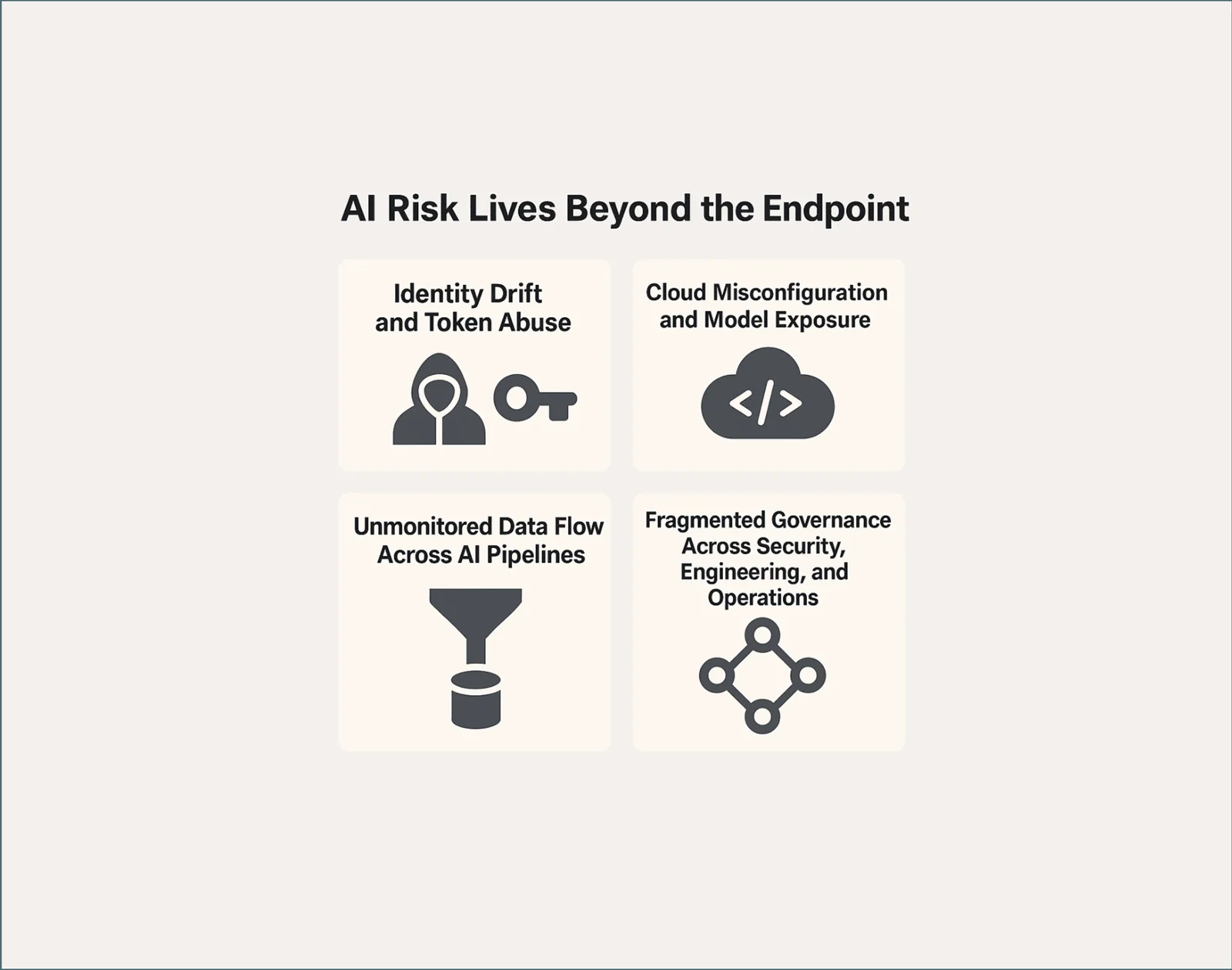
Identity Drift and Token Abuse: Wiz has shown that over permissive service accounts and unmanaged tokens represent one of the fastest growing sources of compromise in AI connected cloud environments. Attackers use these tokens to access data, modify pipelines, and issue requests that appear legitimate. Mandiant reports similar findings in their analysis of cloud incidents. Attackers favor identity misuse because it bypasses device based monitoring entirely.
Cloud Misconfiguration and Model Exposure: Wiz research shows that misconfigured storage, exposed AI service endpoints, and unmanaged public access policies represent the largest category of AI cloud risk. Mandiant's cloud incident analysis confirms that configuration drift and ambiguous ownership create persistent exposure. None of these failures surface in EDR because they occur inside cloud control planes and application services.
Unmonitored Data Flow Across AI Pipelines: NIST AI RMF identifies data movement, data lineage, and data governance as critical areas of AI exposure. Modern AI tools ingest, retrieve, and transform data in ways that bypass traditional security controls. MITRE ATLAS documents multiple adversarial behaviors that target data ingestion and retrieval functions inside AI systems. One of the most concerning patterns involves unauthorized access to vector stores and retrieval outputs. These activities remain invisible when detection stops at the endpoint layer.
Fragmented Governance Across Security, Engineering, and Operations: NIST emphasizes that governance failures are a primary cause of AI risk. Mandiant supports this position through red team findings that show engineering teams deploying AI services without adequate guardrails. Operations, architecture, and security often make decisions independently, which creates misalignment. This misalignment introduces exposure long before a device agent observes activity.
The Rising Cost of Incomplete Telemetry
Incomplete visibility has become one of the most damaging consequences of an endpoint centric strategy. EDR offers a view of device activity. AI driven incidents operate inside identity providers, model pipelines, cloud APIs, and automated workflows. Wiz reports that most enterprises lack unified telemetry across cloud and identity systems. Attackers operate in layers where no sensors exist and the organization remains unaware of the scope of activity.
This creates significant challenges during incident response. A suspicious event may appear on a device, but the investigation cannot follow the trail into cloud workloads or identity providers. Teams cannot determine which accounts were abused or what data was accessed. They cannot identify whether a model or retrieval function was manipulated. NIST AI RMF highlights this risk by stating that evaluation of AI systems requires continuous monitoring across model operations, access pathways, and data handling processes. EDR alone cannot satisfy this requirement.
The problem grows more severe as AI adoption expands. More services connect to more data. More automation relies on privileged identities. More decisions occur away from the device. If visibility stops at the endpoint, the enterprise loses insight into the systems that define its actual exposure. This loss of insight becomes expensive because trust cannot be maintained when the environment is only partially visible.
What I Would Do Instead
A modern AI security strategy should view the attack surface as a connected system rather than a set of devices. The objective is not to replace EDR. The objective is to place EDR in its proper position within a broader architecture.
Place Identity Assurance at the Center of Strategy: Strong identity governance is essential. NIST AI RMF, MITRE ATLAS, and Wiz cloud research all show that identity misuse represents the most common pathway in AI incidents. Monitoring identity behavior must become foundational because AI systems rely heavily on persistent tokens and service accounts.
Strengthen Cloud Posture and Configuration Visibility: AI workloads operate in cloud environments that evolve continually. Continuous configuration monitoring is required to detect drift, exposed APIs, and misaligned access policies. Wiz and Mandiant research confirm that these weaknesses represent the core of AI cloud exposure.
Build Shared Telemetry Across the Entire Environment: Detection must extend through identity systems, cloud workloads, network behavior, API activity, and model operations. NIST AI RMF calls for continuous measurement and management of AI system behavior. MITRE ATLAS catalogs attack techniques that operate in these layers. Unified telemetry is therefore a requirement, not an enhancement.
Govern AI Development and Deployment with Clear Guardrails: NIST stresses the importance of governance alignment across engineering, operations, and security. Guardrails that define which data can be used, how models are deployed, and how API interactions are monitored allow organizations to prevent misconfiguration and reduce accidental exposure.
Promote Cross Functional Coordination: AI connects systems across the enterprise. Security, operations, engineering, compliance, and architecture must move together. Mandiant’s red team findings reveal that misalignment creates persistent exposure. Integrated Assurance offers the structure needed to maintain alignment.
Treat AI Security as an Architectural Responsibility: Microsoft’s Secure AI Framework states that AI must be treated as a system level architectural component. This perspective allows organizations to design controls that span data management, model pipelines, access decisions, and cloud infrastructure. That is where modern AI risk resides.
The Real Story
EDR remains valuable but it is no longer the center of gravity for security strategy. AI driven threats operate inside the relationships between identity systems, cloud environments, data pathways, and governance processes. Mandiant, MITRE, NIST, Wiz, and Microsoft all show that the true attack surface for AI lives outside device boundaries. The organizations that succeed will not be the ones that install more agents. They will be the ones that recognize that AI security is a system level challenge that requires unified telemetry, strong identity governance, cloud maturity, and disciplined oversight.