Risk, compliance, and audit have long been the pillars of enterprise oversight, providing mechanisms to identify, assess, and manage risk while ensuring adherence to standards and validating control effectiveness. However, in many enterprises, these activities operate in isolation where risk teams maintain registers, compliance teams map frameworks, and auditors perform reviews. Each function provides valuable output, yet when disconnected from one another and from operations, they produce more paperwork than resilience.
The Risk, Compliance & Audit Domain within the Integrated Assurance Maturity Model (IAMM) seeks to correct this fragmentation by embedding assurance directly into the daily rhythm of the enterprise. This ensures that risk management becomes active, compliance is harmonized across frameworks, and audit transforms from periodic assessments to continuous validation. Without integration, organizations experience audit fatigue, where overlapping frameworks and uncoordinated audits consume resources while offering little actionable insight.
 Why Risk, Compliance & Audit Matters for Assurance
Risk, compliance, and audit are the connective tissue between governance and operations. They provide the information that guides decisions and the evidence that validates execution. Without them, organizations are blind to exposures and unable to prove defensibility. Yet without integration, they become burdensome. Many enterprises experience what is known as audit fatigue, where overlapping frameworks and uncoordinated audits consume resources while offering little actionable insight. Others struggle with static risk registers that are updated periodically but have little impact on operational behavior. Still others treat compliance as an annual exercise, focusing on certification rather than continuous assurance.
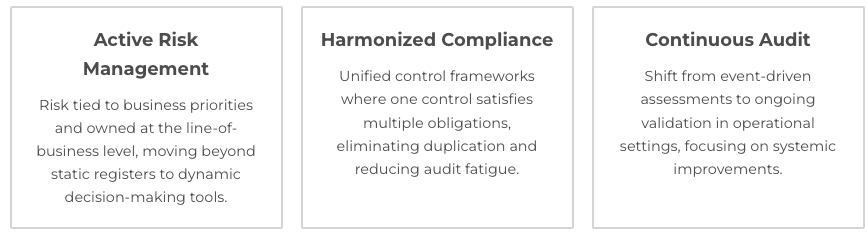
Integrated Assurance requires a different approach. Risk must be tied to business priorities and owned at the line-of-business level. Compliance must be harmonized across frameworks so that one control satisfies multiple obligations. Audit must move from event-driven assessments to continuous validation in operational settings. Together, these shifts transform oversight from reactive reporting into active assurance.
The Evolution of Maturity in Risk, Compliance & Audit
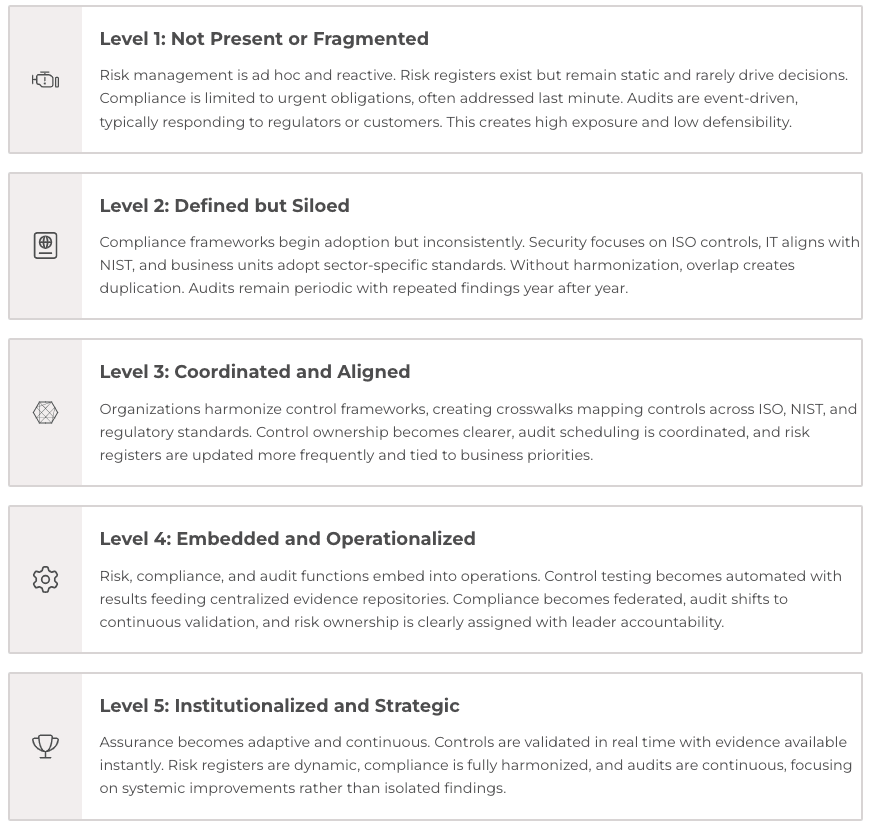
IAMM describes five levels of maturity in this domain, showing how organizations evolve from fragmented oversight to adaptive, continuous assurance.
 Questions for Measuring Maturity in This Domain
Enterprises can measure their maturity by asking targeted questions, such as:
Are control frameworks aligned to avoid duplication and audit fatigue?
Is there a single source of truth for control mapping across standards?
Are control requirements rationalized through crosswalks such as NIST to ISO mappings?
Are controls continuously validated in operational settings rather than only during audits?
Is validation evidence stored centrally and accessible?
Are audit schedules coordinated across teams to reduce disruption?
Are audit findings resolved through root cause analysis rather than surface fixes?
Are systemic gaps identified, tracked, and remediated across domains?
Is operational risk ownership clearly defined at the business-unit level?
Are risk acceptances documented, justified, and reviewed regularly?
Are risk registers actively maintained and tied to business priorities?
Are risks categorized by function and impact, and are they used by leaders to guide prioritization?
These questions reveal whether oversight functions are integrated into operations or remain disconnected exercises.
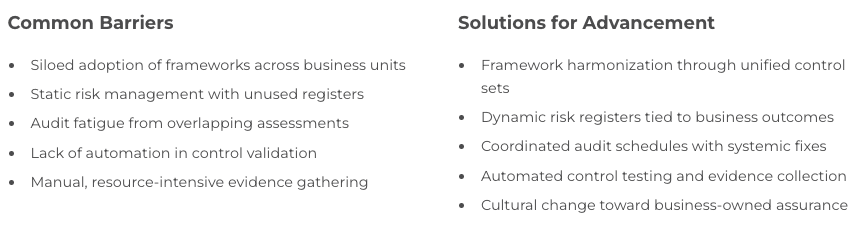
Measuring Maturity and Overcoming Barriers
Enterprises can measure their maturity through targeted questions that reveal whether oversight functions are integrated into operations or remain disconnected exercises. Key questions include whether control frameworks are aligned to avoid duplication, if there's a single source of truth for control mapping, and whether controls are continuously validated in operational settings rather than only during audits.
 The Strategic Value of Risk, Compliance & Audit
At higher levels of maturity, this domain does more than meet regulatory requirements. It creates strategic value. Dynamic risk registers allow leaders to prioritize investments based on real exposure. Continuous compliance reduces disruption and improves efficiency. Automated evidence collection strengthens defensibility with regulators and customers. Continuous audit ensures that systemic weaknesses are addressed. Together, these outcomes improve resilience and build trust.
The strategic value is also cultural. When business leaders own risks, assurance becomes part of the business identity rather than an external requirement. When controls are validated continuously, confidence grows that resilience is real, not just theoretical. When audits focus on systemic improvements, teams see them as opportunities for learning rather than punishments. This cultural shift strengthens the enterprise’s ability to adapt, recover, and sustain trust in volatile conditions.
The Risk, Compliance & Audit Domain is where oversight becomes operationalized. Weakness here leads to audit fatigue, static risk management, and compliance theater. Strength leads to harmonized frameworks, dynamic risk management, and continuous assurance. IAMM provides a roadmap for moving from fragmented oversight to strategic value. By embedding risk ownership at the business level, harmonizing frameworks, automating control validation, and shifting audit from periodic to continuous, enterprises can transform oversight into assurance. This transformation reduces burden, increases defensibility, and strengthens resilience.
Framework Alignment
The Risk, Compliance & Audit domain benefits from frameworks that provide rigor and defensibility. COSO ICIF offers a structured model for building internal controls that support compliance and financial integrity. It provides principles for control environment, risk assessment, and monitoring that align with IAMM’s requirement for harmonized assurance. ISO/IEC 27005 focuses specifically on information security risk management, providing structured methods for risk identification, analysis, and treatment.
The NIST RMF SP 800-37 expands this perspective by defining a lifecycle for categorizing systems, selecting controls, assessing effectiveness, and authorizing operation. It ensures that risk is embedded in system management rather than treated as an isolated exercise. Regulatory frameworks such as PCI DSS, HIPAA, and GDPR reinforce IAMM’s recognition that compliance must be harmonized rather than managed piecemeal. These frameworks demonstrate how industry obligations can be aligned under a unified assurance model.
Audit practices are reinforced by the ISACA ITAF, which defines professional standards for evaluating IT systems. ITAF provides auditors with a common basis for assessing control effectiveness and ensuring defensibility.
IAMM aligns with these frameworks by integrating their strengths into a single operational view. COSO ICIF provides broad internal control principles, ISO 27005 and NIST RMF offer detailed risk practices, regulatory frameworks enforce compliance, and ITAF ensures assurance through audit. Together they create a comprehensive oversight structure that avoids duplication, reduces audit fatigue, and strengthens resilience through continuous validation.