
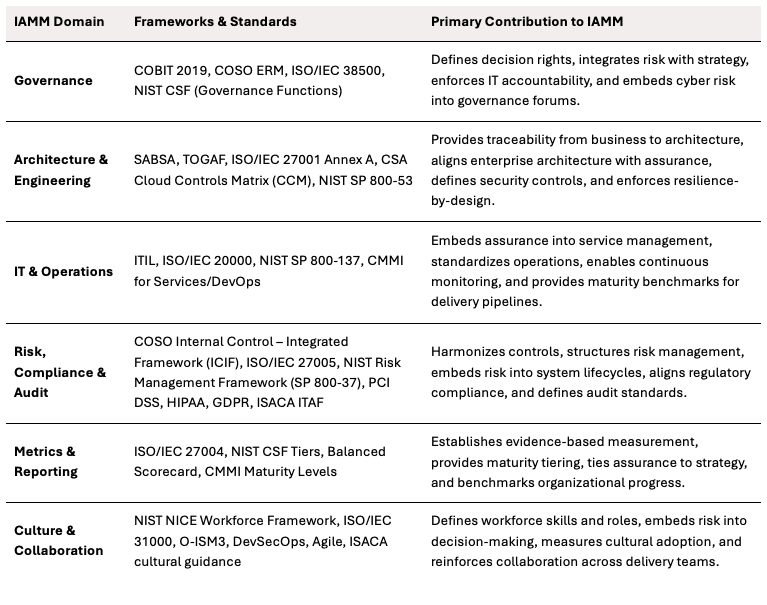
The Integrated Assurance Maturity Model (IAMM) does not exist in a vacuum. It was not designed to replace existing frameworks or to compete with them for organizational attention. Instead, IAMM complements established models by providing the operational connective tissue that many of them lack. It takes the principles of governance, risk management, security architecture, and compliance and translates them into execution that is measurable, sustainable, and cultural.
Organizations often adopt frameworks such as NIST Cybersecurity Framework, ISO/IEC 27001, COBIT, SABSA, COSO ERM, ESRM, and CMMI. Each has strengths and limitations. The challenge for most enterprises is not whether these frameworks are valuable, but whether they can be applied in ways that integrate with daily operations. IAMM was built with this challenge in mind, providing the structure that allows enterprises to draw on the strengths of these frameworks while avoiding fragmentation.
IAMM in Relation to Established Frameworks
 The Distinctive Value of IAMM
What makes IAMM distinctive is its emphasis on operationalization. Many frameworks define principles, categories, or objectives. IAMM defines maturity in ways that are observable, testable, and measurable. For example, in the IT & Operations domain, maturity is demonstrated when baselines are automatically enforced, drift is detected, and recovery practices are continuously validated. In the Architecture & Engineering domain, maturity is visible when policy-as-code ensures compliance in development pipelines.
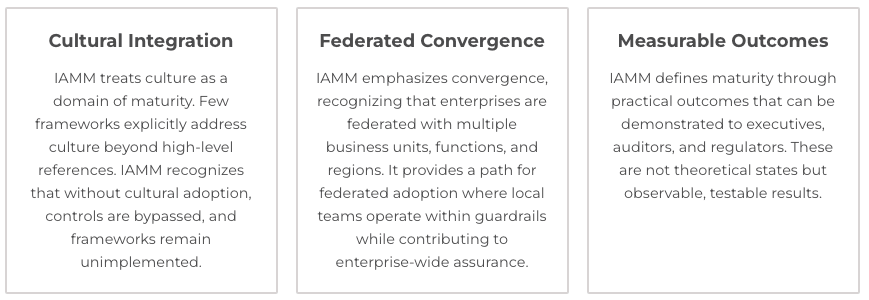 Practical Integration Strategy
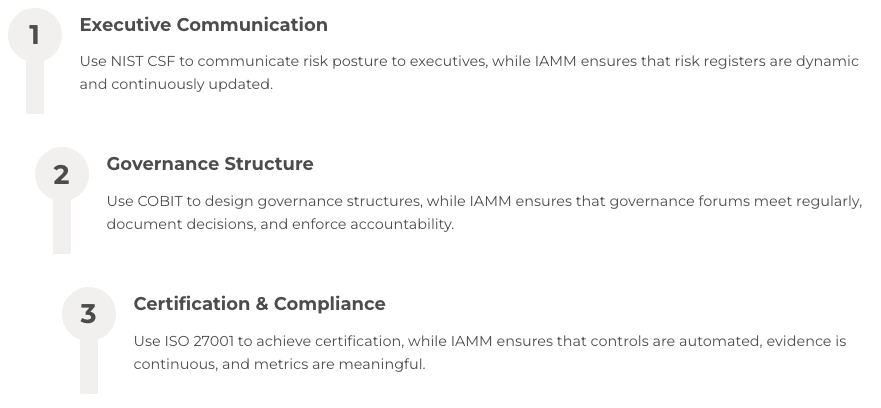
Adopting IAMM does not mean discarding existing frameworks. It means using IAMM as the integration layer that brings them together. This practical integration reduces duplication, eliminates audit fatigue, and creates a coherent assurance system. IAMM becomes the thread that weaves together governance, risk, compliance, architecture, and culture.
 The Strategic Role of IAMM
The adoption of IAMM positions assurance as a strategic enabler. Boards and executives gain confidence because assurance outcomes are measurable and continuous. Regulators and auditors gain confidence because evidence is dynamic and defensible. Customers gain confidence because resilience is demonstrated in practice, not just claimed in policy.
IAMM also supports transformation. Enterprises undergoing cloud migration, modernization, or adoption of artificial intelligence can use IAMM to ensure that assurance is embedded in design and operations. Rather than slowing down transformation, IAMM enables it by providing guardrails that allow innovation to proceed with confidence.
The strategic value extends further. By integrating assurance into culture, IAMM strengthens organizational identity. Assurance becomes part of how the enterprise operates, competes, and sustains trust. It shifts the narrative from compliance to resilience, from risk avoidance to defensible growth.
Final Reflections
IAMM was developed to address a gap that many organizations have struggled with for years. Existing frameworks provide guidance but often leave organizations with fragmented practices and disconnected outcomes. IAMM provides the missing link: a maturity model that embeds assurance into operations, architecture, governance, risk management, metrics, and culture.
By positioning IAMM alongside other frameworks, enterprises can leverage their strengths while addressing their gaps. The result is not another layer of compliance but an integrated capability that sustains resilience. IAMM does not compete with frameworks such as NIST, COBIT, or ISO. It complements them, turning principles into practice and theory into execution.
Enterprises that adopt IAMM will be better prepared for disruption. They will demonstrate resilience not only in reports but also in daily operations. They will be able to show regulators, investors, and customers that assurance is more than an aspiration. It is an embedded, measurable, and cultural capability.
The promise of IAMM is to unify assurance across the enterprise, to bridge the gaps between frameworks, and to ensure that trust and resilience are not left to chance.