IT and operations form the heartbeat of the enterprise, responsible for keeping systems available, ensuring services are delivered, and maintaining the infrastructure that supports every business function. When these functions operate without integrated assurance, they may succeed in meeting uptime targets or delivering new releases, but they often do so at the cost of resilience and security. The result is a fragile enterprise that appears stable until disruption occurs.
When assurance is embedded into IT and operations, however, daily activities reinforce trust. Controls are enforced automatically, recovery practices are validated, and risk is managed alongside performance. This transformation is critical because governance and architecture provide direction, but assurance only becomes real when it is carried out through operations.
 Why IT & Operations Are Critical for Assurance
Governance and architecture provide direction, but assurance only becomes real when it is carried out through operations. IT and operations teams are the ones who manage changes to systems, respond to incidents, and maintain the infrastructure that business services depend upon. If assurance is not present in these workflows, it will not matter how strong governance is or how well architecture is designed. Weakness in operations will undermine both.
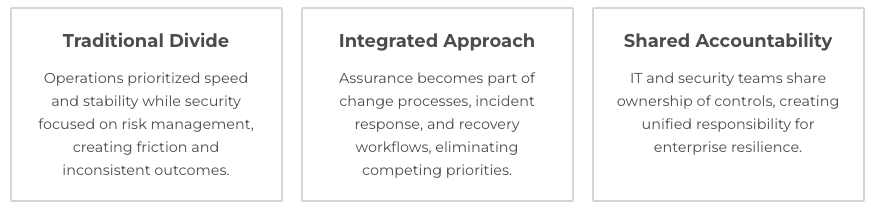
Traditionally, IT operations have been measured by availability, uptime, and service performance. Security was often seen as a separate concern, managed by another function. This created a cultural divide. Operations prioritized speed and stability. Security prioritized risk management. The two perspectives clashed, leading to friction and inconsistent outcomes. Integrated Assurance resolves this divide by embedding security and resilience requirements directly into operational workflows. Assurance becomes part of the change process, the incident response process, and the recovery process. Instead of competing priorities, IT and security share accountability.
The Evolution of Operations Maturity
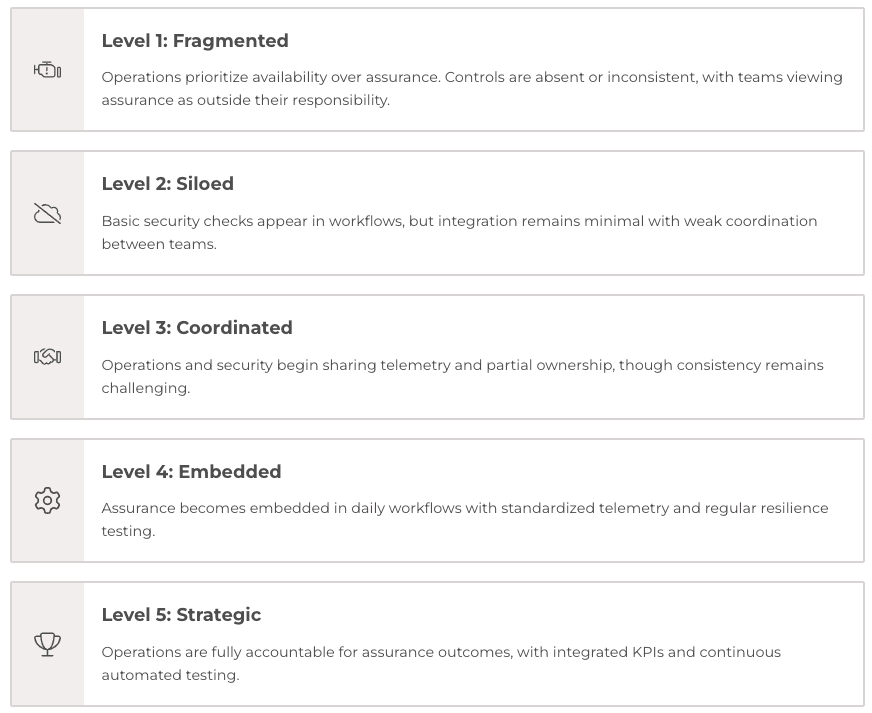
IAMM defines five levels of maturity for the IT & Operations Domain. These levels show how organizations move from fragmented practices to strategic alignment.
 Questions for Measuring IT & Operations Maturity
To measure maturity in this domain, organizations should ask targeted questions, such as:
Are assurance controls embedded in daily workflows for change, incident, and problem management?
Are control failures logged as operational incidents with follow-up action?
Are hardened baselines enforced across systems, and is drift detection in place?
Are exceptions managed through formal and time-bound processes?
Is telemetry from IT and security systems standardized and shared?
Are resilience and recovery practices operationally tested on a regular schedule?
Are backup and recovery processes automated and validated against objectives?
Do operational teams participate in root cause analysis of control failures?
Are risk mitigations logged in user story backlogs or operational plans?
Do teams have KPIs tied to reducing exposure or improving resilience?
These questions reveal whether assurance is truly part of operations or merely an add-on.
Common Barriers to Maturity
Enterprises often struggle in this domain because of cultural divides, tool fragmentation, and lack of accountability. Many IT organizations have long been rewarded for uptime alone. Security requirements may be viewed as slowing down change. Compliance teams may impose requirements without operational feasibility. The result is tension that prevents alignment.
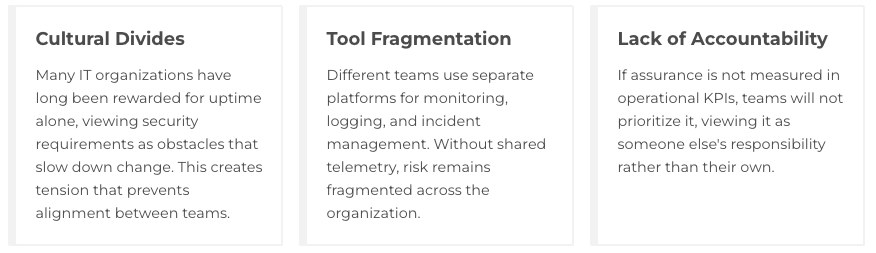 Another barrier is inconsistency in tools. Different teams may use separate platforms for monitoring, logging, and incident management. Without shared telemetry, risk remains fragmented. A further challenge is accountability. If assurance is not measured in operational KPIs, teams will not prioritize it. They may view it as someone else’s responsibility.
Overcoming these barriers requires cultural convergence, tool rationalization, and clear accountability. IT and security must share ownership of controls. Telemetry must be standardized so that risk data is visible across domains. Operational performance must include assurance KPIs. Executives must reinforce that resilience is part of operational excellence.
How Assurance Transforms Operations
When assurance becomes embedded, operations transform from a reactive function to a proactive driver of resilience. Instead of reacting to incidents, teams use telemetry to detect risks early. Instead of treating recovery as a one-time test, they automate recovery validation. Instead of resisting security requirements, they use pre-approved templates and hardened baselines that make compliance easier. Assurance does not slow down operations. It improves predictability, reduces rework, and accelerates delivery.
Mature operations also strengthen enterprise trust. Customers, regulators, and partners gain confidence when operations can demonstrate continuous recovery validation, automated enforcement of controls, and shared accountability with security. Boards gain confidence when operational leaders report on assurance KPIs with the same rigor as uptime or cost metrics.
The Strategic Impact of Mature Operations
When assurance becomes embedded, operations transform from a reactive function to a proactive driver of resilience. Instead of reacting to incidents, teams use telemetry to detect risks early. Instead of treating recovery as a one-time test, they automate recovery validation. Assurance does not slow down operations—it improves predictability, reduces rework, and accelerates delivery.
At higher levels of maturity, IT and operations shape enterprise resilience by influencing investment decisions through control effectiveness data, enabling innovation by ensuring new platforms are deployed with built-in resilience, and strengthening reputation by demonstrating the enterprise can withstand disruption. This transformation is critical in an environment where cyberattacks, outages, supply chain failures, and regulatory changes are recurring realities rather than occasional events.
 Framework Alignment
The IT & Operations domain is supported by frameworks that connect daily service management with assurance. ITIL remains the most widely used reference for IT service management, defining processes for incident, change, and problem management. When combined with IAMM, ITIL practices evolve from efficiency-focused workflows to assurance-driven operations. ISO/IEC 20000 builds on ITIL by providing a certifiable standard for service management, reinforcing consistency across the enterprise.
NIST SP 800-137 introduces a framework for continuous monitoring of information security, providing operational guidance that aligns with IAMM’s emphasis on telemetry and real-time validation. It ensures that operational risk and control performance are visible as part of daily workflows, not only as periodic assessments. CMMI for Services and DevOps extends this foundation by defining maturity practices for service delivery and engineering. These maturity benchmarks map naturally to IAMM’s progression from fragmented to institutionalized operations.
These frameworks strengthen IAMM by embedding assurance within operations instead of leaving it at the governance or compliance level. ITIL and ISO/IEC 20000 bring standardization, NIST SP 800-137 ensures monitoring, and CMMI creates measurable maturity. Together they reinforce IAMM’s vision of operations as the heartbeat of assurance. Organizations that apply these frameworks within IAMM’s structure will move beyond uptime and efficiency metrics to demonstrate operational resilience. They will show that controls are not only designed but also validated in production, making operations a driver of trust rather than a hidden weakness.