
Governance is the foundation of integrated assurance because it establishes the structures, forums, and decision-making frameworks that guide organizational direction. Without governance, assurance activities remain isolated, lacking authority and alignment. With effective governance, assurance becomes more than a collection of controls—it evolves into a coherent capability that connects strategy, risk, and operations.
Governance determines who makes decisions, how those decisions are enforced, and whether risk ownership is distributed in a way that supports accountability. It is not only a matter of creating policies or charters but ensuring that policies translate into operational practice, that forums bring together the right stakeholders, and that executive leaders consistently reinforce assurance as a strategic priority.
 Why Governance Matters for Assurance
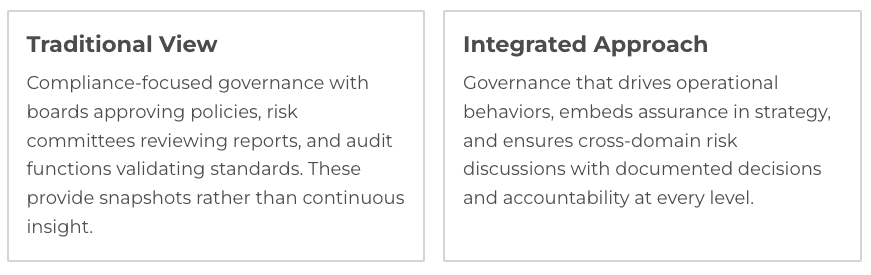
In most enterprises, governance has traditionally been viewed through a compliance lens. Boards and executives approve policies, risk committees review reports, and audit functions validate adherence to standards. These activities are important, but they often fall short of true assurance. They tend to occur in cycles, focused on past performance or regulatory requirements. They provide snapshots rather than continuous insight.
Integrated Assurance requires a different view. Governance must not only satisfy regulatory obligations but also drive operational behaviors. It must ensure that assurance is embedded in strategy, architecture, and operations. This means establishing forums where risks are discussed across domains, ensuring that decisions are documented and acted upon, and requiring accountability at every level of the enterprise. Governance must bring clarity to risk ownership, transparency to exception handling, and consistency to control enforcement.
The absence of effective governance is one of the most common barriers to assurance maturity. When governance is weak, risk decisions are made in isolation. Security teams may impose requirements that delay delivery without understanding business priorities. IT operations may prioritize uptime over resilience without considering security implications. Compliance teams may push for control coverage without assessing impact on engineering workflows. These silos create friction, slow decision-making, and undermine trust. Governance is the mechanism that breaks down these silos and aligns priorities.
Maturity Levels in the Governance Domain
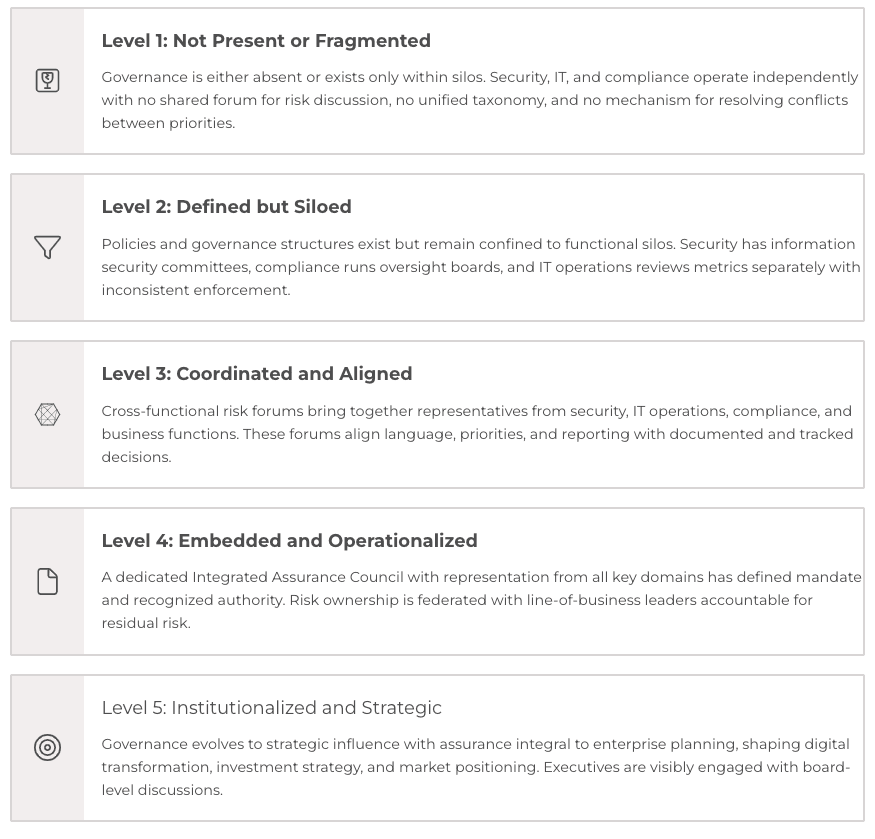
The Governance Domain of IAMM is defined by five levels of maturity. Each level describes how governance evolves from fragmented oversight to institutionalized influence.
 Questions for Measuring Governance Maturity
Assessment in the Governance Domain requires asking targeted questions that reveal the presence, authority, and effectiveness of governance mechanisms. Examples include:
Are there formal cross-functional forums that govern assurance-related decisions?
How often do these forums meet, and what is their documented mandate?
Are decisions consistently documented, tracked, and enforced?
Do representatives from business, IT, security, compliance, and legal participate?
Are risks prioritized jointly, and are exceptions managed transparently?
Is there a shared taxonomy for describing risks and controls?
Is risk ownership federated across the enterprise with accountability at the line-of-business level?
Does executive leadership visibly sponsor assurance initiatives?
Are assurance principles integrated into enterprise strategy and budget cycles?
Are business leaders held accountable for assurance-related objectives in performance reviews?
These questions reveal not just the existence of governance but its effectiveness. An enterprise may have committees and policies, but if decisions are not enforced, or if executive sponsorship is absent, governance remains weak. Maturity requires both structure and influence.
Common Challenges in Governance
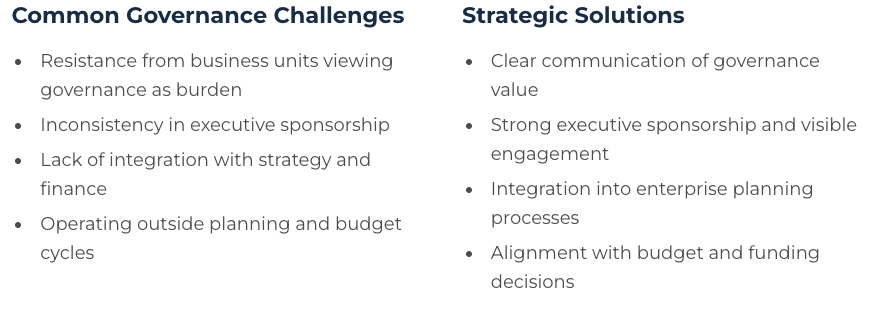
Several challenges commonly prevent organizations from advancing governance maturity. One is resistance from business units that view governance as a burden rather than a partner. Another is inconsistency in executive sponsorship, where leaders delegate responsibility to committees without demonstrating visible engagement. A third is lack of integration with strategy and finance. When governance operates outside planning and budget cycles, it cannot influence priorities.
 The Strategic Role of Governance
At higher levels of maturity, governance plays a strategic role in shaping how the enterprise approaches transformation, modernization, and growth. Assurance becomes a lens through which digital transformation programs are assessed. It becomes part of the criteria for evaluating acquisitions, selecting vendors, and prioritizing investments. Governance provides the forum where trade-offs between speed and security, cost and resilience, innovation and compliance are discussed transparently.
Enterprises that achieve this level of governance maturity treat assurance as a competitive advantage. They can demonstrate resilience to customers, regulators, and investors. They can adapt more quickly to disruption because decisions are made with risk visibility. They can align transformation efforts with defensibility, ensuring that growth does not come at the cost of vulnerability.
Governance is the domain that sets the tone for all others. Without it, assurance remains fragmented and inconsistent. With it, assurance becomes a unifying enterprise capability. IAMM Governance Domain provides a roadmap for evolving from fragmented oversight to strategic influence. By establishing cross-functional forums, embedding accountability, and integrating assurance into strategy, organizations can ensure that governance is not just a policy exercise but a driver of resilience and trust.
Framework Alignment
Frameworks that address governance provide a foundation for translating strategy into consistent oversight. COBIT 2019 defines structures that help boards and executives shape decisions about technology investments, controls, and performance. Its focus on objectives and governance domains aligns with IAMM by clarifying accountability and ensuring that decision rights are distributed across leadership. COSO ERM extends this foundation by linking risk directly to strategy and performance. It highlights how governance must account for uncertainty in planning, resource allocation, and long-term growth.
ISO/IEC 38500 offers guidance on corporate governance of IT. It stresses accountability, responsibility, and ethical use of technology. This aligns closely with IAMM’s vision of governance as an active driver of assurance. Similarly, the NIST CSF v2.0 introduces governance functions that emphasize risk visibility and stakeholder involvement. While NIST focuses primarily on cybersecurity, its governance elements reinforce IAMM’s approach of integrating risk decisions into enterprise forums.
Together, these frameworks ensure that IAMM’s governance domain is not isolated to compliance. They demonstrate how oversight structures support strategy, how risk integration strengthens board confidence, and how accountability drives execution. Organizations can use COBIT to define decision rights, COSO ERM to align risk with performance, ISO 38500 to enforce ethical accountability, and NIST CSF to integrate cyber risk into governance. This blend creates a unified governance capability that goes beyond reporting and becomes a strategic influence on how enterprises sustain resilience and trust.