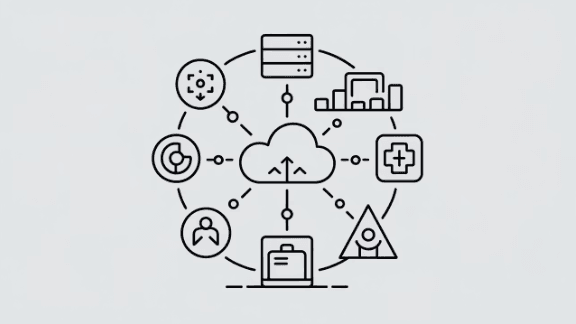
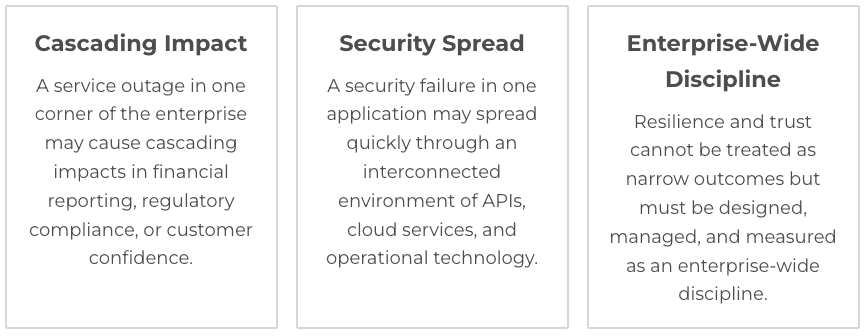
Organizations exist within ecosystems shaped by interconnected digital platforms, third-party dependencies, regulatory demands, and rapidly shifting market conditions. In this environment, risk does not present itself in isolated events but in waves of disruption that travel across business units, supply chains, and customer relationships. A service outage in one corner of the enterprise may cause cascading impacts in financial reporting, regulatory compliance, or customer confidence. Likewise, a security failure in one application may spread quickly through an interconnected environment of APIs, cloud services, and operational technology. The lesson is clear. Resilience and trust cannot be treated as narrow outcomes. They must be designed, managed, and measured as an enterprise-wide discipline.
Traditional governance, risk, and security frameworks have provided essential guidance. Standards such as ISO/IEC 27001, NIST Cybersecurity Framework, COBIT, and CMMI have shaped practices for decades. Each has made important contributions to process improvement, control design, or governance alignment. Yet each tends to remain confined to a single vantage point.
CMMI strengthens process maturity but does not align those processes to security outcomes. NIST provides a tiered approach to cybersecurity governance but stops short of describing operational execution. COBIT builds governance systems but often lacks guidance for daily enforcement. These frameworks offer valuable lenses, but in isolation they create fragmented perspectives.
 Introducing the Integrated Assurance Maturity Model (IAMM)
The Integrated Assurance Maturity Model (IAMM) was developed to address this gap. IAMM is not just another framework layered on top of existing obligations. It is a method for embedding assurance directly into the architecture, operations, governance, and behaviors of the enterprise. It treats assurance as both a discipline and a culture, recognizing that resilience cannot be achieved by technology alone.
 The Integrated Assurance Maturity Model (IAMM) was developed to address this gap. IAMM is not just another framework layered on top of existing obligations. It is a method for embedding assurance directly into the architecture, operations, governance, and behaviors of the enterprise. It treats assurance as both a discipline and a culture, recognizing that resilience cannot be achieved by technology alone. IAMM guides organizations through a structured journey of maturity that begins with fragmented practices and progresses toward institutionalized competence. It provides domains of focus that span governance, architecture and engineering, IT and operations, risk and compliance, metrics, and culture. Each domain has defined maturity levels with guiding questions that allow organizations to measure their progress and identify next steps.
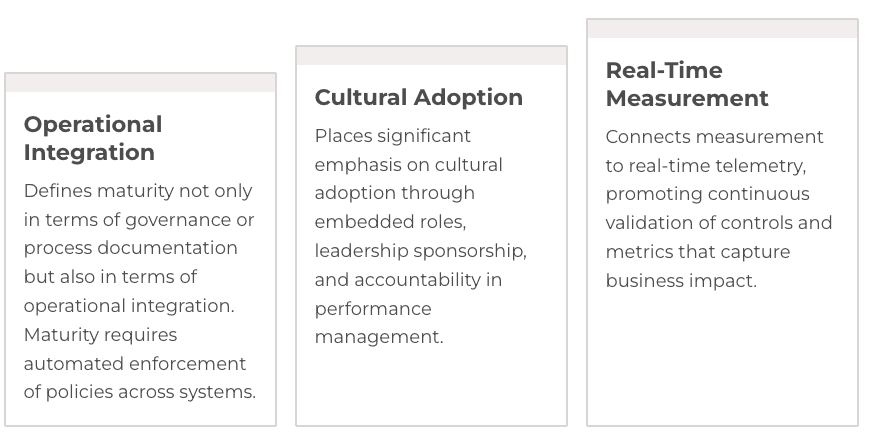
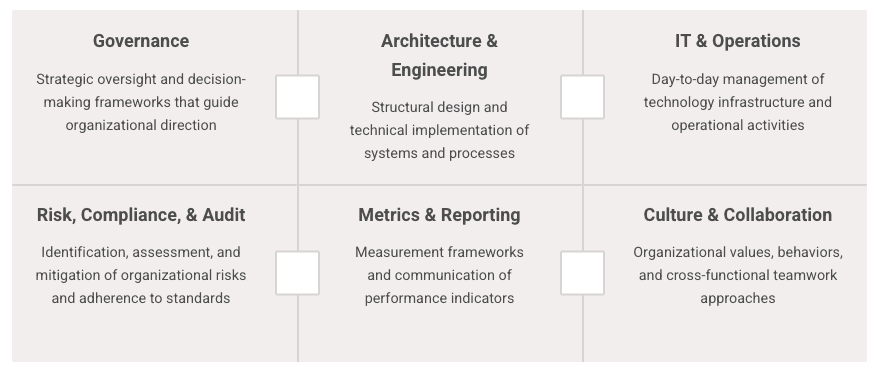 IAMM differs from many traditional models in three important ways. First, it defines maturity not only in terms of governance or process documentation but also in terms of operational integration. For example, maturity in the IT and Operations domain requires not just policies for recovery but automated enforcement of those policies across systems. Second, IAMM places significant emphasis on cultural adoption. Maturity in the Culture and Collaboration domain is not achieved through awareness campaigns alone but through embedded roles, leadership sponsorship, and accountability in performance management. Third, IAMM connects measurement to real-time telemetry. Rather than relying solely on static assessments, it promotes continuous validation of controls, metrics that capture business impact, and reporting that informs strategic decisions.
The introduction of IAMM is timely because enterprises today face risks that cut across traditional silos. The rise of artificial intelligence introduces new vectors for model manipulation, data poisoning, and synthetic deception. Cloud adoption increases dependencies on shared infrastructures and third-party ecosystems. Geopolitical instability brings regulatory fragmentation and supply chain fragility. At the same time, customer trust has become a business currency. A single disruption can erode years of reputation. Organizations must therefore shift their mindset from isolated compliance to integrated assurance. IAMM provides the structure to make that shift possible.
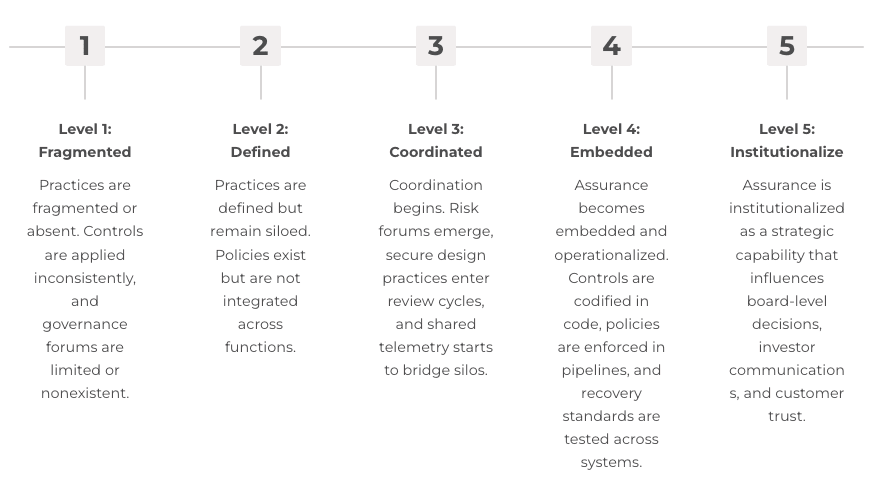
The model is organized into five maturity levels. At the lowest level, practices are fragmented or absent. Controls are applied inconsistently, and governance forums are limited or nonexistent. At the second level, practices are defined but remain siloed. Policies exist but are not integrated across functions. At the third level, coordination begins. Risk forums emerge, secure design practices enter review cycles, and shared telemetry starts to bridge silos. At the fourth level, assurance becomes embedded and operationalized. Controls are codified in code, policies are enforced in pipelines, and recovery standards are tested across systems. At the fifth level, assurance is institutionalized. It becomes a strategic capability that influences board-level decisions, investor communications, and customer trust.
The Five Maturity Levels
Strategic Enabler, Not Defensive Measure
The introduction of IAMM is timely because enterprises today face risks that cut across traditional silos. The rise of artificial intelligence introduces new vectors for model manipulation, data poisoning, and synthetic deception. Cloud adoption increases dependencies on shared infrastructures and third-party ecosystems. Geopolitical instability brings regulatory fragmentation and supply chain fragility.
At the same time, customer trust has become a business currency. A single disruption can erode years of reputation. Organizations must therefore shift their mindset from isolated compliance to integrated assurance. IAMM provides the structure to make that shift possible.
Integrated Assurance is best understood not as a program or a single initiative but as a discipline that permeates every part of the enterprise. It requires intentional leadership, sustained execution, and cultural reinforcement.
Integrated Assurance: unified Risk Strategy invites business leaders to see assurance not as a defensive measure but as a strategic enabler. By embedding assurance into architecture, operations, governance, and culture, organizations create conditions where innovation can proceed with confidence, compliance is sustained without friction, and resilience is demonstrated not only in theory but in practice. IAMM is not the end of the journey but a guide for enterprises that wish to move beyond compliance toward defensible trust.
In my next article in this series I will discuss the Governance domain and how to effective measure and achieve maturity growth using IAMM.