Architecture and engineering represent the critical convergence point where vision meets execution in enterprise assurance. While governance defines principles and direction, this domain determines how those principles are embedded into the systems, services, and platforms that sustain the enterprise. Assurance isn't measured by policy documentation or standards compliance. True assurance measured by whether technology is built to be secure, resilient, and adaptable by design.
Most assurance breakdowns don't originate from governance gaps or compliance failures. They stem from systems built without considering risk, security controls bolted on as afterthoughts, or architectures lacking consistency. Once poor design decisions become embedded, they create long-term fragility, leading to higher costs, slower delivery, and greater exposure. Organizations that mature in this domain take a fundamentally different approach where they embed assurance directly into design and build processes, create reusable patterns, codify security into engineering pipelines, and ensure resilience is non-negotiable in every architecture.
 The Role of Engineering in Assurance
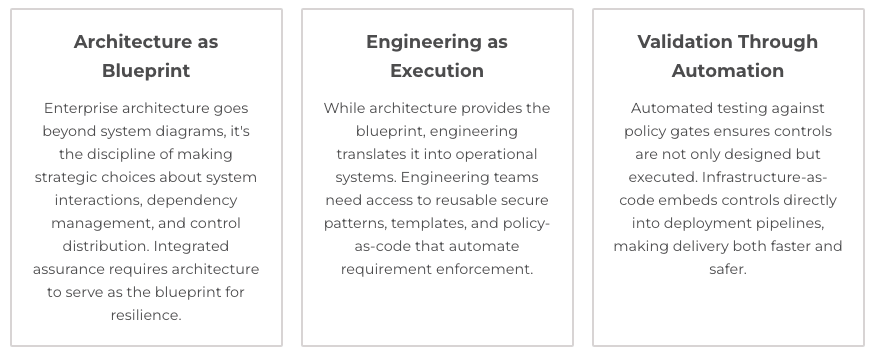
While architecture provides the blueprint, engineering translates it into systems. If engineering is not aligned with assurance principles, even the best designs will fail in practice. Engineering teams must have access to reusable secure patterns, templates, and policy-as-code that automate the enforcement of requirements. Without this, engineers are forced to re-invent controls, leading to inconsistency and drift.
Engineering also plays a critical role in validation. Automated testing against policy gates ensures that controls are not only designed but also executed. Infrastructure-as-code allows controls to be embedded directly into deployment pipelines. When assurance is part of the engineering process, delivery becomes both faster and safer.
Maturity Levels in the Architecture & Engineering Domain
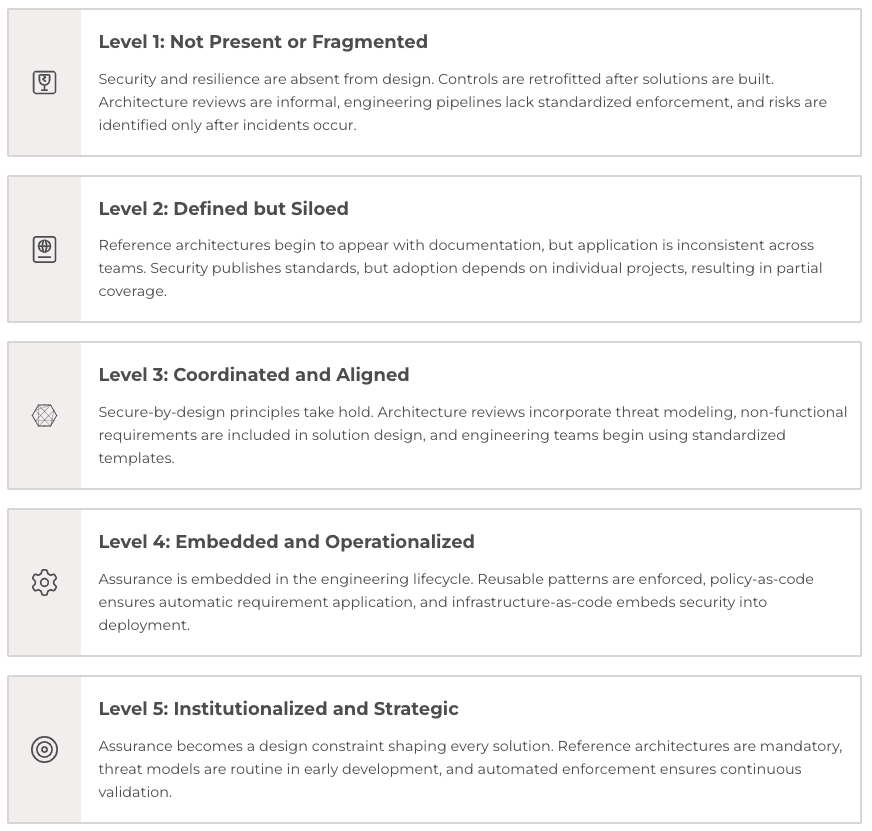
IAMM defines five levels of maturity in this domain, moving from fragmented practices to strategic alignment.
 Questions for Measuring Architecture & Engineering Maturity
To assess maturity, organizations must ask targeted questions that reveal whether assurance is truly embedded. Examples include:
Are secure-by-design and resilient-by-default principles codified in enterprise architecture?
Are threat models used during early design phases, and are they updated as systems evolve?
Do reference architectures and templates include standardized controls?
Are templates updated to reflect emerging threats and new technology stacks?
Are policy requirements traceable to actual controls?
Are policy-as-code and infrastructure-as-code practices applied consistently?
Are code changes tested automatically against policy gates?
Are deviations logged and escalated with accountability?
Are architects involved early in solution design and modernization planning?
Are security requirements treated as non-functional requirements that must be met before delivery?
Is architectural risk tracked and reassessed during implementation?
These questions reveal whether assurance is present at the design table or left to late-stage enforcement.
Common Challenges in the Domain
Enterprises often struggle with this domain for several reasons. One is cultural resistance. Architects and engineers may view security requirements as slowing down innovation. Another is tool fragmentation. Different teams may use inconsistent platforms, making standardization difficult. A third is lack of governance. Reference architectures may exist, but without enforcement, they are ignored. Finally, many organizations fail to invest in automation. Manual enforcement cannot scale, and without automation, consistency is impossible.
Overcoming these challenges requires leadership commitment and investment in both tools and culture. Architects must be trained to see assurance as a design principle, not a constraint. Engineers must be provided with reusable patterns and templates that simplify compliance. Automation must be prioritized to ensure scalability. Governance must enforce adoption while also providing feedback loops that improve patterns over time.
The Strategic Role of Architecture & Engineering
At higher levels of maturity, architecture and engineering become strategic enablers. Assurance is no longer a defensive measure but a way to accelerate delivery. Secure patterns reduce rework. Automated enforcement eliminates bottlenecks. Consistency across systems reduces audit fatigue. Architects play a central role in modernization efforts, ensuring that resilience is built into platforms from the start.
Enterprises at this level can demonstrate defensibility not only through compliance but also through operational practice. They can show customers, regulators, and investors that resilience is built into their systems by design. They can adopt new technologies with confidence because assurance is embedded in their engineering pipelines. They can innovate faster because assurance is automated.
The Architecture & Engineering Domain defines whether assurance is theoretical or operational. Weakness in this domain creates long-term fragility, while strength creates durable resilience. IAMM provides a roadmap for building maturity, from fragmented practices to institutionalized design governance. By embedding assurance into architecture and engineering, enterprises not only reduce risk but also increase their ability to innovate with confidence. Assurance becomes part of the enterprise blueprint, ensuring that every system is built for resilience.
Framework Alignment
The Architecture & Engineering domain is strengthened by frameworks that embed assurance into system design and build practices. SABSA provides a methodology that connects business requirements to security architecture. It ensures that each architectural layer, from conceptual models to operational controls, maintains traceability back to business objectives. This mirrors IAMM’s emphasis on design decisions that embed resilience rather than leaving controls as late-stage add-ons.
TOGAF complements SABSA by defining enterprise architecture practices that align business goals with technology systems. Where IAMM stresses embedding assurance in architecture, TOGAF provides a structural framework for ensuring that architectures remain coherent across business and technology domains. Together, these frameworks encourage design governance that incorporates resilience as a standard requirement.
Standards such as ISO/IEC 27001 Annex A and the CSA CCM define specific security safeguards and cloud control mappings. These support IAMM by providing concrete controls that can be embedded into reference architectures and design templates. The U.S. NIST SP 800-53 catalog adds depth by defining control families that apply across federal and private systems, offering detailed technical measures that align with assurance maturity.
These frameworks collectively help organizations align architecture with defensibility. SABSA ensures business alignment, TOGAF maintains coherence, ISO and CSA provide specific controls, and NIST SP 800-53 reinforces rigor. IAMM integrates them into a maturity journey where architecture evolves from fragmented decisions to institutionalized resilience. The outcome is a consistent blueprint that ensures resilience is engineered into every system and platform.