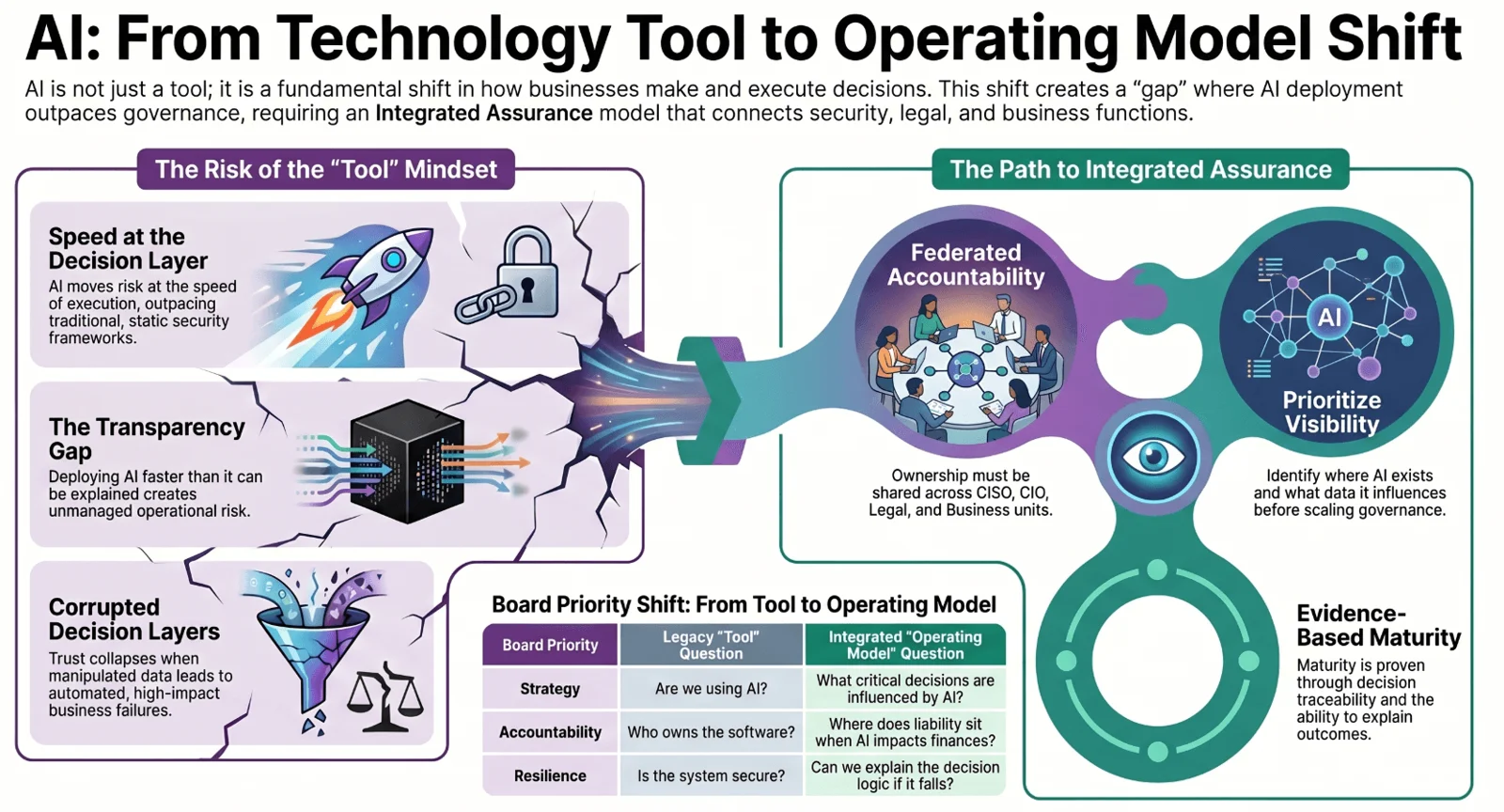
Most discussions about AI focus on what the technology can do. The conversation usually revolves around productivity gains, automation, efficiency, and innovation. Those benefits are real, but they miss the larger story. What makes AI different from previous technology shifts is not simply its capability. It is the role it plays in the business itself.
For years, organizations introduced new systems that helped employees work faster or manage information more effectively. AI is different because it increasingly participates in decision-making. It influences what employees see, what customers experience, how resources are allocated, and how business processes are executed. In many cases, decisions that once required human judgment are now being accelerated, influenced, or automated entirely. That changes the nature of risk.
When organizations deploy a new application, they can usually define its purpose, establish ownership, and manage its impact. AI often reaches across multiple functions at once. It touches data, operations, customer interactions, financial decisions, and security controls simultaneously. As a result, a mistake made by an AI-enabled process can spread far beyond the technology team. The challenge is that many organizations are adopting AI faster than they understand its business impact.
The excitement is understandable. Leaders see opportunities to improve productivity, reduce costs, and move faster than competitors. Business units are eager to experiment. Employees are finding their own ways to use AI tools. New capabilities appear almost weekly. Unfortunately, governance rarely moves at the same pace.
This creates a growing gap between adoption and oversight. The technology enters the business quickly, but visibility, accountability, and operational understanding often arrive much later. By the time leadership begins asking questions, AI may already be influencing important business decisions. That is where the conversation needs to change.
Organizations should not be asking whether they are using AI. Most already are. The better question is where AI is influencing decisions and how much the business depends on those decisions being correct.
Consider a large manufacturing company using AI to forecast inventory requirements, optimize purchasing, and manage supply chain activities. At first, the results are positive. Costs decrease, forecasting improves, and operations become more efficient. The problem appears when conditions change unexpectedly.
A supplier disruption, cyber incident, or data quality issue introduces inaccurate information into the process. The AI system continues producing recommendations, and employees continue acting on them because the system has become trusted. What started as a data problem quickly becomes an operational problem. Inventory shortages emerge. Production schedules slip. Customer commitments are missed. At that point, the organization is no longer dealing with a technology issue. It is dealing with a business issue.
The real question becomes whether leaders can trust the decisions being made and whether they can explain those decisions when customers, regulators, auditors, insurers, or shareholders start asking questions. That is where many organizations discover their greatest weakness.
When something goes wrong, they cannot clearly identify who owns the process. They struggle to explain how decisions were made. Different departments provide different answers. Security focuses on the systems. Legal focuses on liability. Operations focuses on restoring productivity. Leadership is left trying to understand what happened while confidence across the organization begins to erode. Trust rarely disappears all at once. It erodes gradually.
Employees become hesitant to rely on outputs. Managers introduce manual reviews to compensate for uncertainty. Customers receive inconsistent explanations. Recovery slows because nobody is completely confident in the information available to them. The technology may still be functioning, but the business no longer trusts it. This is why AI governance cannot be treated as a security problem alone.
Security remains important, but many of the largest risks associated with AI are operational. They involve decision quality, accountability, resilience, and business continuity. They require participation from business leaders, legal teams, risk managers, auditors, operations leaders, and technology teams.
The organizations making the most progress are beginning to recognize this reality. Rather than viewing AI as a standalone technology initiative, they are treating it as a business capability that requires shared ownership. They know where AI is being used. They understand what data supports it. They can identify which business processes depend on it. They have established accountability for outcomes rather than simply accountability for systems. Most importantly, they can explain what happened when something goes wrong.
Customers want transparency. Regulators want accountability. Insurers want evidence that risks can be understood and managed. Boards want confidence that AI-driven decisions will not create unexpected liabilities. None of those stakeholders care whether an organization has an AI policy sitting on a shared drive. They care whether the organization can operate effectively when conditions become difficult.
The first step is surprisingly simple and it start with visibility.
Before building governance committees, drafting extensive policies, or launching large transformation programs, organizations need to understand where AI already exists. They need to identify what data it touches, what decisions it influences, and what business processes depend on it. Only then can leaders begin building the operational guardrails needed to support growth.
The companies that succeed with AI will not necessarily be the ones that deploy it fastest. They will be the ones that understand how deeply it affects the way their businesses operate. The conversation is about operational trust. And that is a business problem long before it becomes a technology problem.