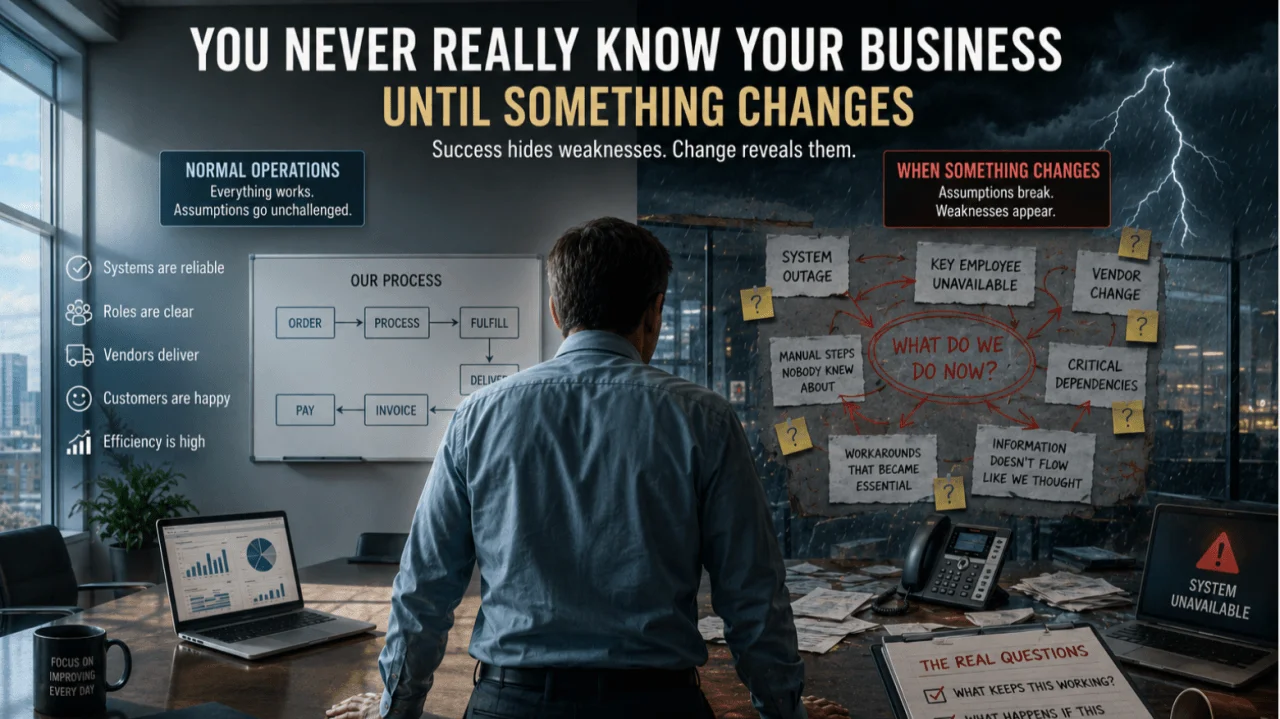
Most businesses spend years optimizing for efficiency and very little time understanding how they would operate if that efficiency suddenly disappeared. That is not a criticism. It is simply the result of success. When systems are reliable, suppliers deliver on time, employees know their roles, and customers remain satisfied, there is little reason to question assumptions that have worked for years. Eventually, though, something changes.
Sometimes it is a software outage that lasts longer than expected. A supplier misses a critical shipment. A long-time employee retires with knowledge that was never transferred. A key vendor changes the way its platform works. A customer demands a different way of doing business. Sometimes it is a cyberattack. The event itself is almost secondary. What matters is that the interruption forces the business to operate differently than it did the day before. Those moments have a way of exposing things that were invisible during normal operations.
Processes everyone believed were well understood suddenly depend on one individual who happens to be unavailable. Information that appeared to flow automatically turns out to rely on manual steps that nobody remembered existed. Teams discover they have been using the same workaround for years without realizing it had become essential to keeping the business moving. Dependencies that seemed insignificant when they were created have quietly become critical to day-to-day operations.
None of those conditions developed overnight. They were built one practical decision at a time, often by people who were doing exactly what the business needed them to do. The interruption simply brings them into view.
This is one of the reasons I have become increasingly interested in business survivability. The conversation is often framed around preventing disruption, but prevention has never been the complete story. Businesses operate in environments they cannot fully control. Markets shift. Technology evolves. People leave. Vendors change direction. Unexpected events will always occur. The question is not whether every disruption can be prevented. The question is whether the business understands itself well enough to adapt when the unexpected happens. That requires a different perspective.
Instead of asking whether a particular system is secure, it becomes more useful to ask what happens if that system is unavailable. Instead of assuming a process is resilient because it has worked for years, it is worth understanding what keeps it working in the first place. Those questions move the conversation away from individual technologies and toward the business itself. They encourage leaders to think less about isolated risks and more about the relationships that allow the organization to continue creating value when circumstances change. A disruption rarely teaches a business something entirely new. More often, it reveals something the business had stopped seeing.