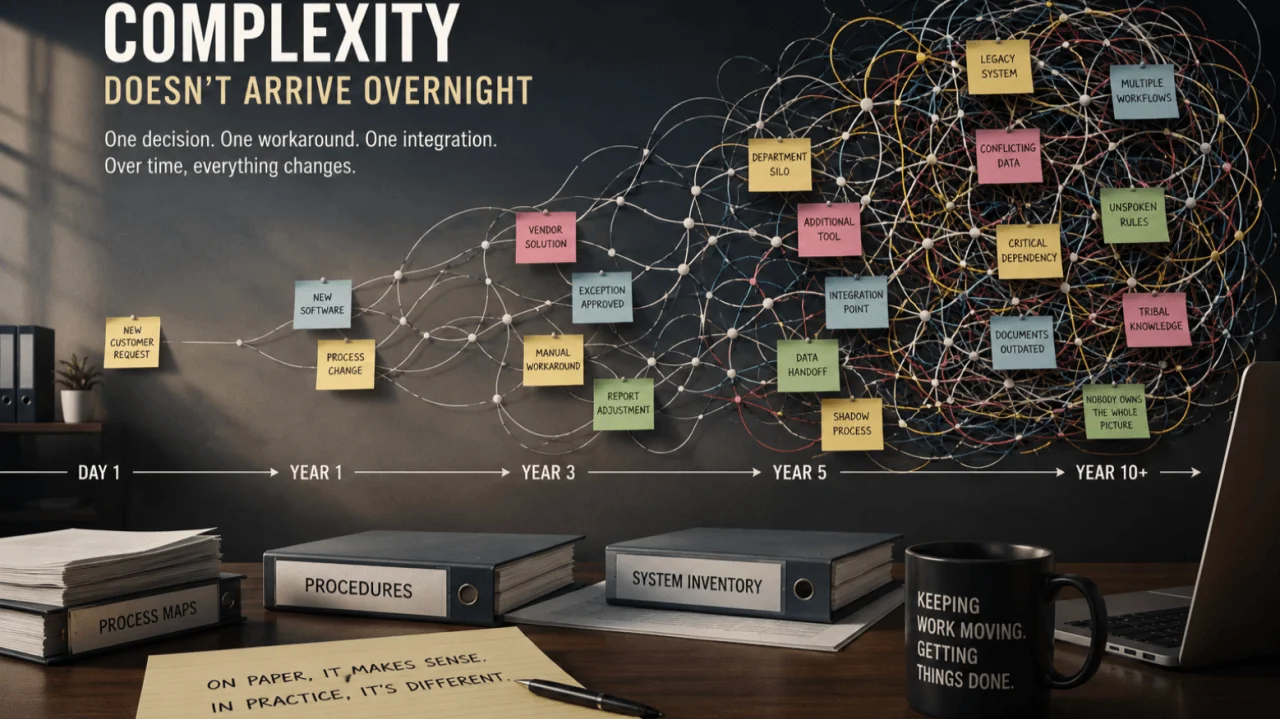
People often talk about complexity as though it arrives with size. Reach a certain number of employees, open another location, acquire another company, and complexity simply appears. My experience has been very different. Complexity has much less to do with size than it does with accumulation.
Businesses are constantly solving problems. That is what they are supposed to do. Every time an obstacle gets in the way of serving customers, improving efficiency, or supporting growth, someone finds a solution. Sometimes it is a new piece of software. Sometimes it is a revised process. Sometimes it is nothing more than an experienced employee deciding there is a better way to accomplish a task. The solution works, everyone moves on, and the business continues growing.
The interesting part is that businesses rarely stop to examine what those individual decisions look like after years of continuous change. Each solution is designed to solve an immediate problem, not to describe how the organization should operate ten years later. Viewed in isolation, every decision appears reasonable. Viewed together, they tell the story of a business that has been evolving almost continuously since the day it was founded.
I have walked into organizations that believed they had a clear understanding of how work flowed from one department to another. On paper, they usually did. There were process maps, documented procedures, application inventories, and organizational charts. Those documents reflected thoughtful planning and good governance. They simply could not keep pace with the reality of a business that continued changing every week.
The real operating model always lived somewhere else. It existed in the conversations between experienced employees, in the adjustments people made to keep work moving, and in the practical knowledge that never seemed important enough to document because everyone involved already understood it. New employees learned those routines by watching others rather than by reading procedures. Managers made decisions based on experience instead of diagrams. Teams developed their own rhythms because they were trying to serve customers, not preserve documentation.
None of this suggests the business is poorly managed. Quite the opposite. It usually reflects an organization full of capable people making sensible decisions. The challenge is that every adaptation changes the business just a little. One change is insignificant. Hundreds of them create an organization that operates very differently from the one leadership believes they are managing.
That gap rarely becomes obvious during normal operations. Customers continue placing orders, employees keep solving problems, and the business continues growing. Success has a way of creating confidence that everything is working as intended because, on the surface, it is. There is little reason to question the way work gets done when the outcomes remain positive.
The challenge only becomes apparent with time. As the business continues to evolve, fewer people retain a complete understanding of how everything fits together. Knowledge becomes distributed across teams, systems become increasingly interconnected, and important decisions begin relying on assumptions that have never been tested because they have never needed to be.