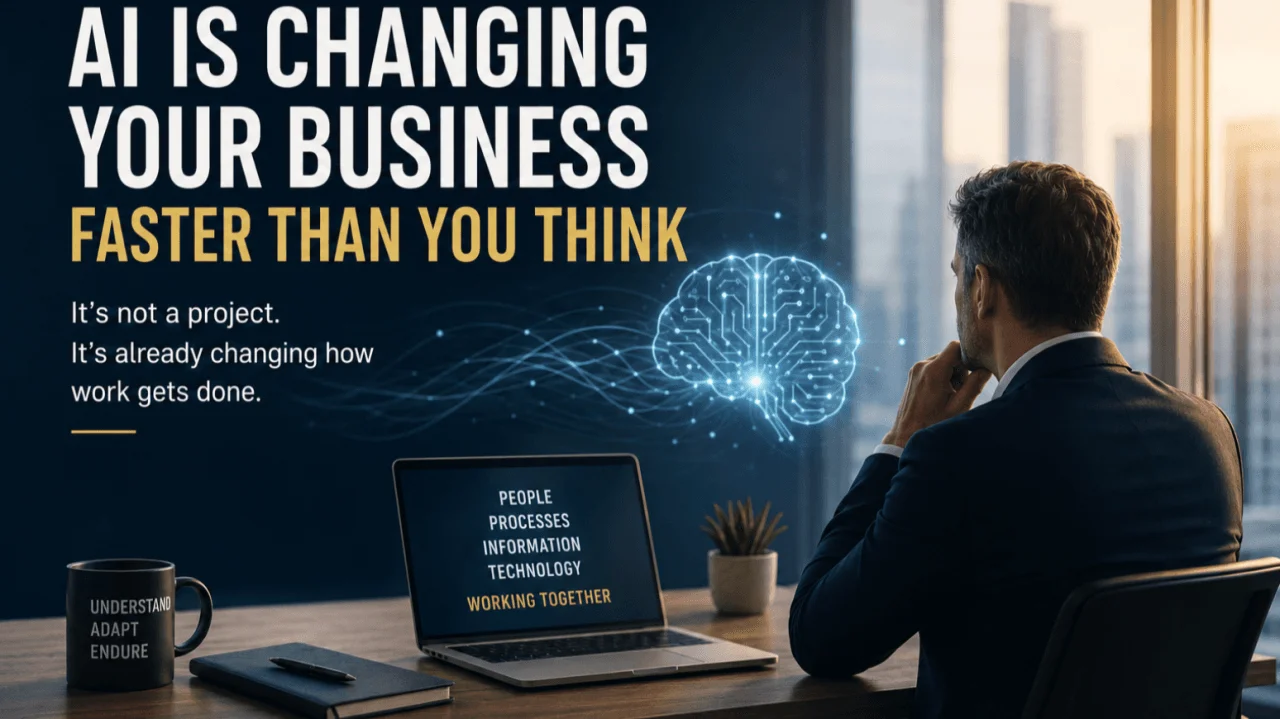
The challenge of understanding a growing business is not new. Organizations have been adapting to changing markets, new technologies, and evolving customer expectations for decades. What is new is the speed at which those changes are now taking place.
Artificial intelligence is becoming part of everyday business in ways that are easy to overlook because most organizations are not adopting it through a single transformation project. It arrives through the software they already use. Accounting platforms introduce automated analysis. Customer relationship systems begin drafting communications. Productivity applications summarize meetings, generate reports, and recommend decisions. Business owners rarely wake up one morning intending to become an AI-driven organization. They simply accept another software update and continue running the business.
Every one of those improvements has the potential to create value. They reduce administrative effort, improve consistency, and allow employees to focus on work that requires judgment rather than repetition. For many organizations, these capabilities will become an important competitive advantage. They also change how work gets done.
A decision that was once made by an experienced employee may now begin with a recommendation generated by software. Information that once moved directly between departments may now pass through applications that analyze, summarize, or transform it before another person ever sees it. Responsibilities shift without anyone formally redefining them because the technology quietly changes the work itself.
None of this suggests businesses should slow their adoption of artificial intelligence. The opportunity is too significant to ignore. It does, however, increase the importance of understanding how the organization actually operates. Every new capability changes relationships between people, processes, information, and technology. As those relationships become more interconnected, they also become more difficult to recognize without making a deliberate effort to understand them. That is why I believe business survivability deserves far more attention than it receives today.
For years, organizations have treated cybersecurity, operational resilience, governance, compliance, business continuity, enterprise risk management, and technology strategy as separate conversations. Each discipline addresses an important part of the problem, but none of them, by themselves, explain whether the business can continue creating value when conditions change.
Business survivability begins with the questions of whether you understand your business as it exists today or are you still managing the version you remember? That question has everything to do with awareness.
Growth should make an organization more capable. It should also deepen its understanding of itself. When those two things continue to grow together, businesses become stronger with every stage of their development. When they begin to drift apart, complexity quietly fills the space between them until an unexpected interruption exposes what nobody realized had changed.
Most business leaders spend their careers trying to build a stronger company. The companies that endure are usually the ones that never stop learning what they have become.