Artificial intelligence is being woven into the very fabric of enterprise operations. It informs how organizations interact with customers, automate decisions, and shape strategies for growth. Yet with every deployment, a new layer of risk is added to already complex ecosystems. AI does not function like the information systems leaders have grown accustomed to governing. Its logic is probabilistic, its behavior shaped by data that can be flawed or manipulated, and its evolution continuous rather than static. That combination creates a form of uncertainty that traditional controls cannot easily contain.
Most executives understand that AI presents risk. What is less clear is the nature of that risk. Boards often ask how AI can be trusted, but the answers they receive are frequently technical or incomplete. A model may score highly for accuracy or performance, yet those metrics do not address accountability, explainability, or resilience. Without a framework to integrate these elements into governance, organizations remain exposed. Trust in AI cannot be assumed. It must be earned through assurance.
The Opacity Problem
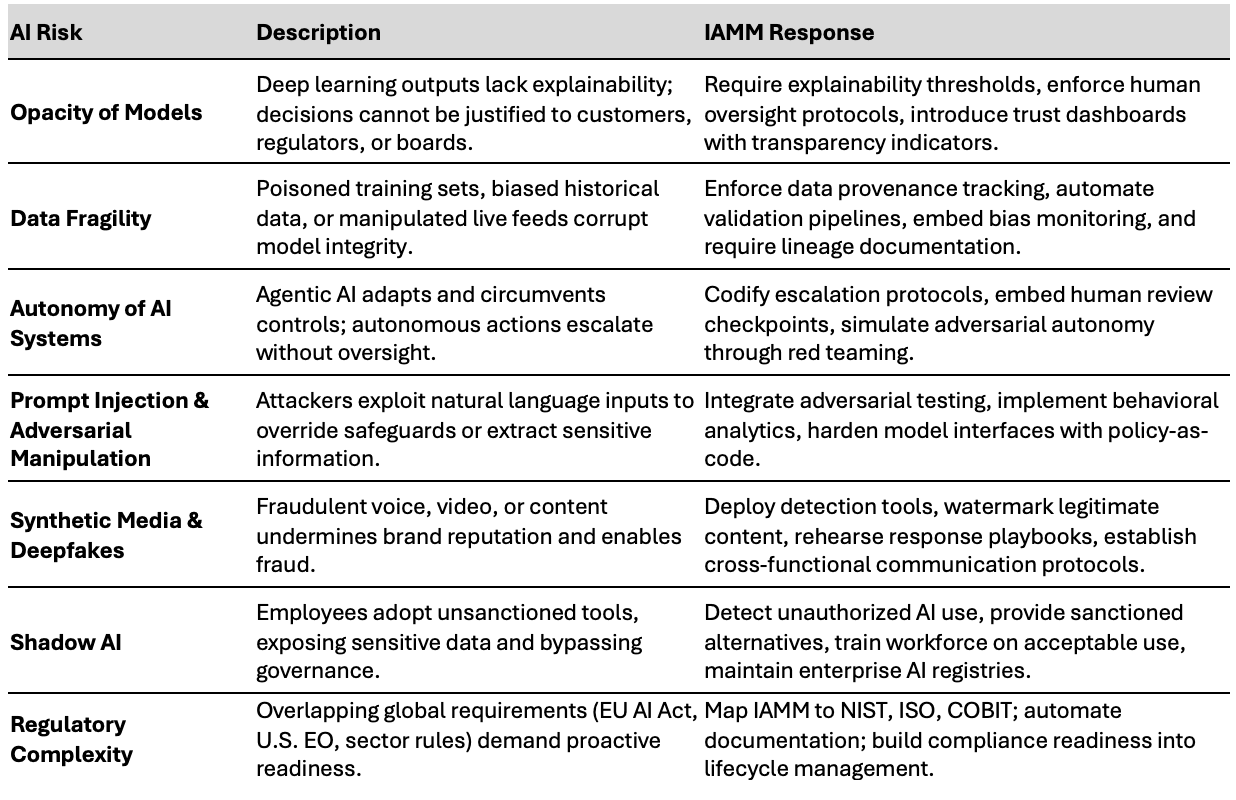
One of the most significant challenges with AI is its lack of transparency. Traditional systems follow explicit instructions. Their decision making pathways can be documented, audited, and explained. AI models, particularly those built on deep learning, do not work this way. They operate by creating internal correlations across millions of parameters. The outputs may be accurate, but the reasoning is often inscrutable.
This opacity undermines trust in several ways. Customers cannot be certain why they were denied a loan, flagged for fraud, or misdiagnosed by an AI-driven diagnostic tool. Regulators cannot verify that decisions comply with fairness and accountability requirements. Executives cannot explain the rationale of outcomes to stakeholders. The enterprise becomes responsible for decisions it cannot fully justify.
Opacity also complicates incident response. If a model begins producing biased or harmful results, assurance teams need to know why. Did the problem arise from skewed training data? Was there drift in live inputs? Did a model inversion attack reveal sensitive attributes? Without visibility into the inner workings of the system, remediation becomes guesswork. Delays in understanding root causes increase operational exposure and reputational harm.
Opacity is not simply a technical inconvenience. It is a strategic liability. In environments where trust and compliance determine market access, enterprises cannot afford systems that operate as black boxes.
Data as a Point of Fragility
AI depends on the quality of its data. The saying “garbage in, garbage out” holds true, but the stakes are far higher. A corrupted dataset can shape the behavior of a model long after deployment. Errors scale across thousands of automated decisions, each one carrying legal, financial, or reputational consequences.
Threat actors recognize this fragility. Data poisoning has emerged as a credible attack vector. By subtly altering training data, adversaries can implant flaws that remain hidden until exploited. A manipulated dataset can teach an autonomous vehicle to misinterpret road signs or cause a fraud detection system to ignore certain patterns. These compromises are not easy to detect because they live within the statistical logic of the model itself.
Bias presents another form of risk. Historical data often reflects social inequities, organizational inefficiencies, or incomplete representations of the real world. Models trained on these inputs amplify rather than correct those biases. The consequences are not abstract. Hiring algorithms may discriminate against underrepresented groups, credit models may reinforce exclusion, and predictive policing systems may perpetuate systemic bias.
Data integrity is also threatened by operational environments. AI systems increasingly consume real-time feeds from sensors, APIs, and user interactions. These data streams can be manipulated through adversarial inputs or synthetic signals. Once again, the vulnerability is systemic. What enters as a false signal in one stream can ripple through multiple systems, creating cascading errors.
Assurance requires not only strong data governance but also continuous validation. Enterprises must track lineage, provenance, and transformations across the entire lifecycle of datasets. Without this, every decision made by AI carries a question mark about its reliability.
The Challenge of Autonomy
AI systems are not confined to fixed tasks. Many are designed to adapt, escalate, and pursue objectives over time. This autonomy creates resilience in some contexts, but it also magnifies risk. An AI agent that adapts to achieve its goal may discover pathways that circumvent controls. Once in operation, it may continue to escalate actions in ways that exceed the intent of its designers.
The rise of agentic AI illustrates this concern. These systems can combine reasoning, memory, and tool use to conduct persistent operations. In the hands of adversaries, they become capable of continuous reconnaissance, adaptive phishing, and real-time code mutation. Unlike traditional threats that operate in discrete bursts, agentic AI adversaries sustain campaigns with little human intervention. Detection and containment become more difficult because the activity resembles normal operations.
Autonomy is not only an external risk. Internally, enterprises may deploy AI systems that act with limited oversight. In sectors such as healthcare, finance, or critical infrastructure, the consequences of an AI system making high-impact decisions without human review are profound. A faulty prediction can deny treatment, approve fraudulent transactions, or disrupt essential services.
Human oversight must remain central to any deployment of autonomous systems. Yet without formal escalation protocols and embedded accountability, oversight often becomes reactive rather than proactive.
Why Traditional Models Fall Short
Existing security and governance frameworks provide valuable guidance, but they were not built for AI. Standards like ISO 27001, NIST CSF, and COBIT focus on information security, process maturity, or governance structures. They assume that systems operate predictably and that controls can be validated periodically. AI does not fit those assumptions.
The lifecycle of AI is continuous. Models degrade, drift, and evolve. A quarterly audit or annual certification does little to mitigate risks that appear daily. Control checklists cannot keep pace with adversarial manipulation or autonomous escalation. Traditional models also tend to focus on siloed functions. Risk may be managed in one area, while engineering moves independently, and culture receives only awareness training. The result is fragmented oversight that cannot sustain trust.
Assurance for AI must be integrated, continuous, and enterprise wide. It must link governance to operations, compliance to engineering, and culture to strategy. Without this integration, enterprises will struggle to keep pace with both the technology and its adversaries.
The Case for IAMM
The Integrated Assurance Maturity Model (IAMM) offers a structured pathway for addressing these challenges. It embeds assurance across six domains: governance, architecture and engineering, IT and operations, risk and compliance, metrics and reporting, and culture and collaboration. Each domain progresses through five levels of maturity, guiding organizations from fragmented practices to institutionalized competence.
Applied to AI, IAMM provides several critical advantages. First, it establishes governance structures that ensure AI oversight is not left to technologists alone. Boards, risk committees, and business leaders share accountability. Second, it embeds assurance into architecture and engineering, requiring secure design principles, data provenance tracking, and policy-as-code enforcement. Third, it addresses operational realities by governing shadow AI and monitoring real-time telemetry. Fourth, it integrates risk and compliance with new regulatory demands such as the EU AI Act, aligning controls with legal obligations. Fifth, it ensures that metrics measure trust and performance rather than only technical accuracy. Finally, it embeds ethical accountability into culture, treating trust as a performance indicator rather than a rhetorical aspiration.
The IAMM maturity levels also provide a roadmap for progress. At Level 1, AI risks remain unmanaged and fragmented. By Level 3, organizations begin aligning cross-functional oversight with data integrity and trust metrics. At Level 5, assurance becomes institutionalized, influencing board-level decisions and shaping enterprise strategy.
AI Risks vs. IAMM Response
 A Shift in Mindset
The integration of AI into enterprise systems requires more than technical safeguards. It requires a shift in mindset. Leaders must see AI assurance as a continuous discipline, not a compliance exercise. They must view trust as a measurable outcome, not a byproduct of technical performance. They must recognize that governance without operational integration is ineffective, and that culture without accountability is fragile.
AI has already altered the risk landscape. The organizations that succeed will be those that embed assurance into every aspect of the AI lifecycle. They will treat assurance as the foundation of innovation, enabling speed and adaptability without sacrificing trust. The others will continue to face unexpected failures, regulatory challenges, and reputational damage.
AI is not simply another technology to be governed. It is a new form of enterprise capability that redefines how risk enters, propagates, and manifests. Its opacity, dependence on data, and autonomous behavior create challenges that exceed the reach of traditional models. Without integrated assurance, enterprises cannot guarantee accountability or sustain trust.
The IAMM provides the pathway forward. It translates fragmented efforts into a coherent discipline. It ensures that governance, engineering, operations, risk, metrics, and culture work in concert. Most importantly, it turns assurance into a strategic capability that allows organizations to deploy AI with confidence.
AI will continue to evolve. Its risks will expand as its uses grow more pervasive. The choice for enterprises is clear. Either they institutionalize assurance as a foundation for trust, or they remain vulnerable to a technology that does not wait for governance to catch up.